Mounjaro for Weight Loss UK: Eligibility, Doses, Results & Side Effects


Get our latest weight-loss and health guides straight to your inbox.
Mounjaro for Weight Loss in the UK: A Complete 2026 Guide
Mounjaro® is the brand name for tirzepatide, a prescription-only medicine used in the UK for type 2 diabetes and, separately, for weight management in eligible adults.
Tirzepatide has attracted significant attention because clinical trials have demonstrated substantial average weight reduction in some adults when treatment is combined with a reduced-calorie diet and increased physical activity.
However, Mounjaro is not simply a “weight-loss injection”. It is a prescription medicine with eligibility criteria, potential side effects and important safety considerations. Treatment should form part of a wider medical weight-management plan that considers nutrition, physical activity, monitoring and long-term weight maintenance.
This guide explains how Mounjaro works, who may be eligible in the UK, the different doses, what clinical studies have shown, potential side effects, NHS access and what good medical weight-management care should involve.
Mounjaro: quick answers
| What is Mounjaro? | Mounjaro contains tirzepatide, a medicine that acts on GIP and GLP-1 receptors. |
| Is Mounjaro licensed for weight management in the UK? | Yes, in eligible adults alongside a reduced-calorie diet and increased physical activity. |
| What BMI is required? | Under the UK licence, generally BMI ≥30 kg/m², or ≥27 kg/m² with at least one weight-related health condition. |
| How often is it taken? | Once weekly by subcutaneous injection. |
| What is the starting dose? | 2.5mg once weekly. |
| What is the maximum adult dose? | 15mg once weekly. |
| How much weight was lost in major trials? | In SURMOUNT-1, average weight loss reached 22.5% at 72 weeks in the 15mg treatment group. |
| Is Mounjaro prescription-only? | Yes. A clinical assessment is required before prescribing treatment. |
The current UK product information confirms the dosing schedule, licensed indication and clinical-trial results outlined above.
What is Mounjaro?
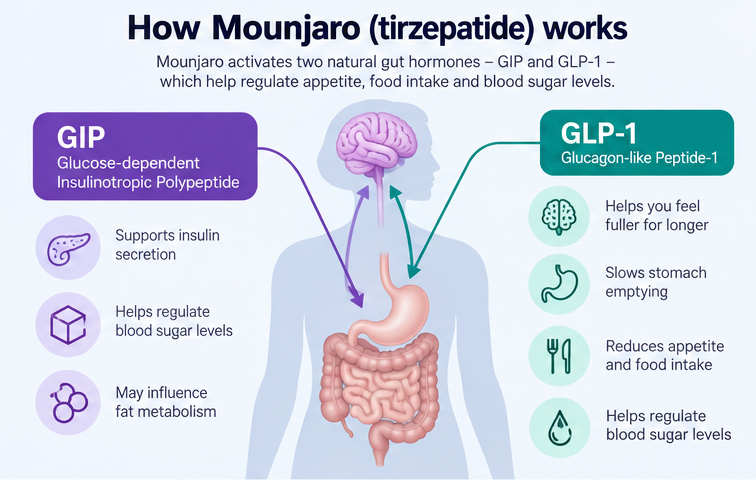
Mounjaro contains the active ingredient tirzepatide.
Tirzepatide acts on two hormone receptors involved in appetite regulation and metabolism:
GIP, or glucose-dependent insulinotropic polypeptide, and GLP-1, or glucagon-like peptide-1.
Because it acts on both pathways, tirzepatide is commonly described as a dual GIP and GLP-1 receptor agonist.
For weight management, Mounjaro is licensed in eligible adults as an addition to a reduced-calorie diet and increased physical activity.
It is administered by injection under the skin once each week.
Mounjaro is a prescription-only medicine. An appropriately qualified prescriber must assess suitability before supplying treatment.
How does Mounjaro help with weight loss?
Tirzepatide affects signalling involved in appetite and food intake.
It can increase feelings of fullness, reduce hunger and reduce food intake. Tirzepatide also slows gastric emptying, particularly when treatment is first started.
For some people, these effects make it easier to maintain a calorie deficit and establish different eating patterns.
This does not mean Mounjaro physically “burns fat” or removes the need to address lifestyle.
Medical weight management still needs to consider areas such as food quality, protein intake, fibre, physical activity, resistance training, sleep, behavioural habits and longer-term maintenance.
That distinction matters because losing weight and successfully managing weight long term are not necessarily the same thing.
Who may be eligible for Mounjaro for weight loss in the UK?
Under the current UK licence, tirzepatide can be used for weight management in eligible adults with an initial:
BMI of 30 kg/m² or above
or
BMI from 27 kg/m² to below 30 kg/m²
where at least one weight-related health condition is also present.
Examples in the UK product information include high blood pressure, abnormal blood fats, obstructive sleep apnoea, cardiovascular disease, prediabetes and type 2 diabetes.
Meeting these BMI criteria does not automatically mean Mounjaro is suitable for you.
A prescriber must consider your wider medical history, current medicines, previous treatment, potential interactions, risks, treatment goals and whether another approach may be more appropriate.
The licensed eligibility criteria are confirmed in the current UK Summary of Product Characteristics.
Is private Mounjaro eligibility different from NHS eligibility?
Yes.
This distinction matters and is often misunderstood.
The marketing authorisation determines the population for which the medicine is licensed.
The NHS commissioning criteria determine which patients currently qualify for NHS-funded treatment.
NICE recommends tirzepatide as an option for managing overweight and obesity in adults with a BMI of at least 35 kg/m² and at least one weight-related comorbidity when it is the most appropriate treatment option.
NHS England is introducing access in phases because the potentially eligible population is very large.
From around June 2026, the phased primary-care implementation includes certain people with a BMI between 35 and 39.9 kg/m² who also have four or more specified weight-related conditions. Different BMI thresholds apply to some ethnic groups.
This means you may meet the licensed criteria for private treatment without currently meeting the criteria for NHS-funded treatment.
Can Mounjaro be prescribed privately in the UK?
Yes.
An appropriately qualified UK prescriber can prescribe tirzepatide privately when treatment is clinically suitable.
Private prescribing still requires an individual clinical assessment.
A responsible assessment should consider more than BMI alone. Relevant areas can include your medical history, current medicines, previous weight-management treatment, eating patterns, diabetes risk, cardiovascular risk, gastrointestinal history, pregnancy intentions and your broader treatment goals.
Make the decision about which treatment, if any, is appropriate after the assessment, not in advance.
How effective is Mounjaro for weight loss?
The SURMOUNT-1 trial studied tirzepatide in adults with obesity, or overweight plus at least one weight-related health condition, who did not have type 2
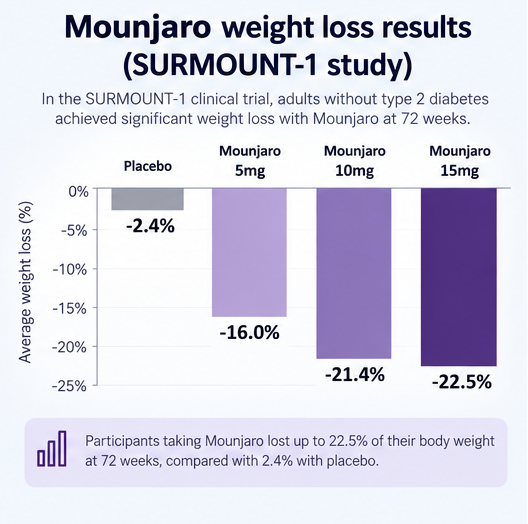
The SURMOUNT-1 trial studied tirzepatide in adults with obesity, or overweight plus at least one weight-related health condition, who did not have type 2 diabetes.
At 72 weeks, average body-weight changes were:
| Treatment | Average change in body weight |
|---|---|
| Tirzepatide 5mg | -16.0% |
| Tirzepatide 10mg | -21.4% |
| Tirzepatide 15mg | -22.5% |
| Placebo | -2.4% |
Participants also received a lifestyle intervention focused on reduced-calorie intake and increased physical activity.
These percentages are clinical-trial averages.
They should not be interpreted as a guarantee that an individual taking Mounjaro will lose the same amount.
Response can vary based on starting weight, dose, tolerability, treatment duration, diet, physical activity, medical conditions, other medicines, adherence, and individual biology.
How quickly does Mounjaro work?
No single timeline applies to everyone.
Some people notice changes in appetite relatively early in treatment, while weight change should generally be assessed over months rather than days or individual weeks.
Treatment also begins at a low dose and increases gradually.
Your first few months therefore include both adaptation to the medicine and, where clinically appropriate, gradual dose escalation.
Day-to-day or week-to-week changes on the scales are also affected by fluid balance, bowel movements, food intake and other factors.
A longer-term trend is generally more informative than one isolated weight measurement.
What are the different Mounjaro doses?
Mounjaro KwikPens are available in:
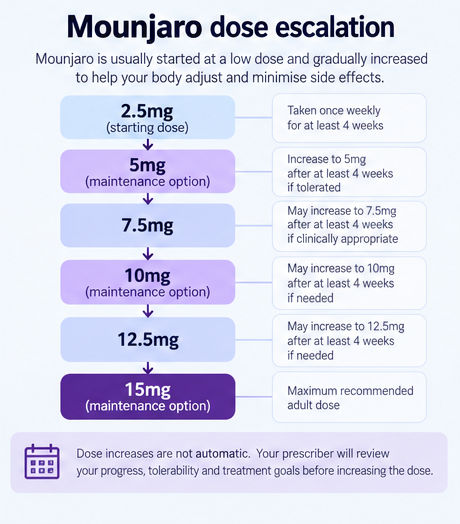
Treatment starts at 2.5mg once weekly.
After four weeks, the dose is normally increased to 5mg once weekly.
If a further increase is clinically appropriate, doses can then be increased in 2.5mg increments after at least four weeks at the current dose.
The recommended adult maintenance doses are 5mg, 10mg and 15mg, with 15mg being the maximum adult weekly dose.
Do you have to increase your Mounjaro dose every month?
No.
The objective should not be to reach 15mg as quickly as possible.
A higher dose is not automatically better.
Decisions about dose escalation should consider treatment response, appetite, weight trajectory, tolerability, gastrointestinal symptoms, and other clinical factors.
Some people may stay on a recommended maintenance dose longer when it is effective and well tolerated.
Agree on dose changes with the prescriber responsible for your treatment.
Can you stay on Mounjaro 5mg?
Yes.
The current UK product information identifies 5mg, 10 mg, and 15mg as recommended adult maintenance doses.
That means patients do not need to progress automatically from 5mg through every higher dose.
The most appropriate dose is an individual clinical decision.
What happens if weight loss slows down?
A weight-loss plateau does not automatically mean treatment has stopped working.
As body weight decreases, the amount of energy needed to maintain the smaller body also falls. Appetite, activity and eating patterns can change, and short-term scale readings can be influenced by fluid balance and bowel contents.
The first step should therefore be to look at the overall trend rather than reacting to a few days without weight loss.
It may also help to review calorie intake, protein, fibre, physical activity, resistance exercise, sleep, alcohol intake, medication adherence, and whether appetite suppression has changed.
Don’t treat dose escalation as the automatic answer to every plateau.
Does Mounjaro reduce fat or muscle?
Significant weight loss typically involves some loss of both fat mass and lean tissue.
In a body-composition sub-study of SURMOUNT-1, tirzepatide produced a greater reduction in fat mass than lean mass.
However, preserving muscle remains important during medical weight loss.
Adequate protein intake, appropriate resistance exercise, and avoiding unnecessarily aggressive calorie restriction can help protect lean mass and maintain physical function.
This is one reason medical weight management should look beyond the number on the scale.
[INTERNAL LINK: Protein During Medical Weight Loss — How Much Do You Need?]
What are the most common Mounjaro side effects?
The most commonly reported side effects are gastrointestinal.
These include nausea, diarrhoea, vomiting, constipation and abdominal discomfort.
Gastrointestinal symptoms occur more frequently during dose escalation and often become less prominent over time.
In pooled SURMOUNT-1 and SURMOUNT-2 data, gastrointestinal disorders occurred in approximately 56% of participants taking tirzepatide compared with approximately 30% taking placebo. Most reported events were mild or moderate.
Side effects should still be taken seriously, particularly when symptoms are persistent, severe or interfere with hydration or nutrition.
Can Mounjaro cause dehydration?
It can contribute indirectly.
Vomiting and diarrhoea can lead to fluid loss, and significant dehydration can affect kidney function.
Maintaining appropriate fluid intake is therefore particularly important if you experience gastrointestinal symptoms.
Persistent vomiting, inability to keep fluids down, reduced urination, marked dizziness or significant deterioration should prompt medical advice.
What serious side effects should you know about?
Most people taking tirzepatide will not experience a serious adverse reaction, but recognising important warning symptoms matters.
Persistent, severe abdominal pain can be associated with acute pancreatitis and requires urgent medical assessment.
Gallstones and gallbladder inflammation can also occur, particularly with substantial or rapid weight loss.
Severe allergic reactions are uncommon but require emergency treatment.
Do not rely on an online article to assess severe or rapidly worsening symptoms.
Is Mounjaro safe?
Mounjaro is a licensed prescription medicine, but licensed does not mean risk-free.
Safety depends partly on selecting appropriate patients, using the medicine correctly, reviewing other medications, and responding appropriately to side effects.
Tirzepatide may require particular caution in people with certain gastrointestinal conditions or a history of pancreatitis.
People using insulin or sulphonylureas for diabetes may also have an increased risk of hypoglycaemia and can require changes to their diabetes treatment.
A complete clinical assessment is therefore important before starting treatment and during follow-up.
Mounjaro and the contraceptive pill
Tirzepatide delays gastric emptying.
The current UK product information states that reduced effectiveness of oral contraceptives cannot be excluded in women with overweight or obesity.
It therefore advises switching to a non-oral contraceptive method or adding a barrier method for four weeks after starting tirzepatide and for four weeks after each dose increase.
If you use oral contraception, discuss this with your prescriber.
Can you use Mounjaro during pregnancy?
No.
The current UK product information states that tirzepatide should not be used during pregnancy.
If you are planning pregnancy, tirzepatide should be discontinued at least one month before a planned pregnancy because of its long half-life.
If you become pregnant while taking treatment, contact your healthcare professional.
Can Mounjaro be used while breastfeeding?
UK product information changed in 2026 as additional data became available.
A study involving 11 women found tirzepatide concentrations in breast milk were undetectable or very low after a single 5mg dose.
The current UK SmPC states that tirzepatide could be considered during breastfeeding, although it also notes uncertainty around whether reduced maternal food intake may alter breast-milk composition or nutritional content.
This therefore requires an individual clinical discussion, rather than treating breastfeeding as an automatic yes or no.
What happens if you miss a Mounjaro dose?
If you miss a dose, the current product information advises taking it as soon as possible if no more than four days have passed.
If more than four days have passed, skip the missed dose and take the next dose on the normal scheduled day.
You can also change the dosing day when needed, as long as there are at least three days between doses.
A longer interruption differs from a missed injection.
If you have stopped treatment for a longer period, contact your prescriber rather than automatically restarting at your previous dose.
How should Mounjaro be stored?
Before use, store the KwikPen in the refrigerator at 2°C to 8°C, and do not freeze it.
After first use, you may store the pen outside the refrigerator for up to 30 days, provided the temperature does not exceed 30°C. It should then be discarded.
Always follow the storage information supplied with your own medicine.
Is Mounjaro intended to be short-term?
Not necessarily.
The UK indication includes weight loss and weight maintenance.
Obesity is increasingly managed as a long-term condition rather than something that is “cured” once a particular number appears on the scales.
That means an effective treatment plan should consider what happens after the initial weight-loss phase.
For some people, this can involve continued pharmacological treatment. For others, the longer-term strategy may change.
The decision should be individualised and reviewed clinically.
What happens when you stop Mounjaro?
Appetite may increase after treatment stops, and weight regain can occur.
This does not mean everybody will regain all of the weight they have lost.
It does mean that stopping treatment without a maintenance strategy can make long-term weight management more difficult.
Planning should therefore consider eating patterns, protein and fibre intake, physical activity, resistance training, sleep, behavioural habits and how increased appetite will be managed.
Can you switch Mounjaro providers?
Yes. Patients receiving private medical weight-management care can change providers.
However, your new prescriber remains independently responsible for deciding whether ongoing prescribing is appropriate.
They may ask for evidence showing your previous treatment, the dose you have been using, when medication was last supplied, your starting weight or BMI and how you have responded to treatment.
A previous prescription does not automatically guarantee that a new provider will prescribe the same dose.
Treatment gaps also matter because restarting after an interruption may require a different clinical decision than continuing uninterrupted treatment.
That is why switching should involve a proper transfer of care, not just ordering another pen from a different website.
What if my BMI is now lower because treatment has worked?
This is especially important for people transferring providers.
Someone may have started treatment at a BMI that met the eligibility criteria and subsequently lost enough weight for their current BMI to fall below that threshold.
That does not mean their treatment history should simply be ignored.
The new prescriber needs to assess the patient’s starting position, treatment response, current circumstances and maintenance needs rather than looking at one current BMI number without context.
Continuity still requires clinical assessment, evidence of previous treatment and a prescribing decision.
How much does Mounjaro cost privately in the UK?
The cost of private treatment varies significantly between providers and can change over time.
Comparing only the medicine price can also be misleading because different services include very different levels of clinical support.
When comparing private medical weight-management providers, look at what the overall programme actually includes.
One service may primarily provide prescribing and medication. Another may include clinical reviews, access to prescribers, nutrition support, digital monitoring, blood testing, body-composition assessment, face-to-face appointments or maintenance support.
The relevant comparison is therefore not necessarily:
“Who has the cheapest pen?”
It is:
“What clinical service am I receiving around the prescription?”
Do I need blood tests before taking Mounjaro?
Not everyone requires exactly the same investigations.
The need for blood testing depends on factors such as medical history, symptoms, medicines and existing health conditions.
In some people, blood tests may help assess metabolic health or identify conditions relevant to weight management.
Depending on circumstances, this could include glucose control, kidney function, liver function, thyroid function, lipid profile, or nutritional status.
Order blood tests only when clinically indicated, not simply because someone is using weight-loss medication.

What should medical weight-loss monitoring include?
Monitoring should look beyond whether the number on the scales has decreased.
A clinically structured programme can consider treatment response, side effects, medication dose, blood pressure, waist measurement, nutritional intake, activity, body composition and relevant blood results when indicated.
Longer-term reviews should also consider whether treatment remains beneficial, whether the current dose is still appropriate and what the maintenance plan looks like.
Tailor the level of monitoring to the individual rather than applying an identical package to every patient.
What should a good medical weight-management service include?
The medicine is only one component.
A structured service should start with a meaningful clinical assessment and then provide appropriate follow-up throughout treatment.
Patients should understand how their treatment works, what side effects to watch for, how doses are reviewed, when to seek help, and what the longer-term plan is.
Nutrition should be addressed because major calorie reduction without adequate protein, fibre and micronutrient intake is not good weight management.
Physical activity and resistance exercise should also be considered, particularly where preserving muscle and physical function is a priority.
Finally, the service should have a maintenance plan, rather than assuming care ends as soon as the patient reaches a particular target weight.
What does digital wraparound support mean?
Medical weight management does not only happen during a consultation.
Questions, side effects, changes in appetite, dietary challenges and changes in motivation often happen between appointments. This is where digital wraparound support can add value.
At Puri Pharmacy, eligible patients can receive additional digital support alongside their clinician-led weight-management care.
The aim is not to replace contact with a healthcare professional. Instead, digital support helps maintain continuity between clinical reviews and encourages patients to remain engaged with the wider behaviours that support long-term weight management.
Support between appointments
Rather than waiting until the next formal review to think about progress, digital support can help patients stay engaged with areas such as:
- treatment progress
- eating patterns
- hydration
- protein and fibre intake
- physical activity
- side effects
- treatment adherence
- weight-management goals
Regular check-ins can also help identify when additional clinical input may be appropriate.
Building healthier habits around treatment
Prescription medication can influence appetite, but medication alone does not automatically establish the habits required for long-term weight management.
Digital wraparound support can reinforce areas such as:
Nutrition
Helping patients think about food quality, adequate protein, fibre and overall nutritional intake rather than simply eating less.
Activity
Encouraging appropriate movement and resistance exercise to support physical health and help preserve muscle during weight loss.
Consistency
Providing prompts and structured check-ins that help patients stay engaged with their programme between clinical appointments.
Education
Helping patients better understand their treatment, common challenges and the lifestyle factors that influence long-term outcomes.
Digital support alongside clinical care
Puri Pharmacy uses digital health technology as an additional layer around our clinician-led service.
Patients may be supported through Aide Health, which provides structured digital support between consultations.
This allows the weight-management journey to continue outside the consultation room while clinical decisions — including prescribing, dose changes and management of significant side effects, remain the responsibility of an appropriately qualified healthcare professional.
Digital tools should therefore be viewed as an extension of clinical care, not a substitute for it.
Why does wraparound support matter?
Weight management is rarely a single decision followed by a straight line of progress.
Patients can experience periods of rapid progress, plateaus, changing appetite, side effects, holidays, illness, changes in routine or difficulties maintaining new behaviours.
Having support between appointments means these challenges do not necessarily have to wait until the next scheduled consultation.
A more complete weight-management model therefore looks like:
clinical assessment → appropriate treatment → digital support → nutrition → activity → monitoring → regular review → long-term maintenance
This is different from a model focused solely on supplying medication.
Medical weight management at Puri Pharmacy
Puri Pharmacy provides a clinician-led medical weight-management service for adults seeking structured clinical support.
Our model combines remote care with face-to-face clinical support through our pharmacies in Southall and Hillingdon, West London.
This means patients can access support nationally, while those living around Southall, Hillingdon, Uxbridge, Hayes, Ealing and surrounding West London areas can also access in-person care.
Our approach extends beyond prescription supply and can include ongoing clinical review, digital support, nutrition guidance, body-composition monitoring and blood testing where clinically indicated.
When prescription treatment is being considered, we decide the appropriate option after an individual clinical assessment.
We cannot guarantee a specific prescription medicine or dose before assessment.
Frequently Asked Questions About Mounjaro
Is Mounjaro the same as Ozempic?
No.
Mounjaro contains tirzepatide.
Ozempic contains semaglutide and is licensed in the UK for type 2 diabetes.
Wegovy also contains semaglutide but has a separate licence for weight management in eligible patients.
Do not treat the medicines as interchangeable.
Is Mounjaro a GLP-1 medicine?
Partly.
Tirzepatide activates the GLP-1 receptor but also activates the GIP receptor.
It is therefore more accurately described as a dual GIP and GLP-1 receptor agonist.
What is the starting dose of Mounjaro?
The starting dose is 2.5mg once weekly.
After four weeks, it is normally increased to 5mg once weekly. Further increases can be made in 2.5mg steps after at least four weeks at the current dose when clinically appropriate.
What is the highest Mounjaro dose?
The maximum recommended adult dose is 15mg once weekly.
Does everybody need 15mg?
No.
The recommended maintenance doses are 5mg, 10 mg, and 15mg.
Treatment should be individualised according to response and tolerability.
How much weight can you lose with Mounjaro?
In SURMOUNT-1, average weight change at 72 weeks was -16.0% with 5mg, -21.4% with 10mg and -22.5% with 15mg, compared with -2.4% with placebo.
These are averages from a controlled clinical trial and do not predict an individual’s result.
Can I get Mounjaro on the NHS?
Mounjaro is available through the NHS for some eligible adults, but NHS access is being introduced gradually and has narrower criteria than the medicine’s licensed indication.
Eligibility depends on factors including BMI and specified weight-related health conditions.
Can I switch from another provider?
Yes, but the new provider will normally need to assess your current treatment and may request evidence of previous prescribing.
The new prescriber must decide whether your treatment and current dose remain appropriate.
Can I use Mounjaro if my BMI is now below 27?
Current BMI should not necessarily be considered without your treatment history.
Someone who has successfully lost weight during treatment may now have a substantially lower BMI than when treatment started.
Continuation or transfer therefore requires an individual clinical assessment considering the original indication, treatment response and maintenance needs.
Can I drink alcohol while using Mounjaro?
There is no blanket prohibition on alcohol in the product information.
However, alcohol contributes calories, can worsen some gastrointestinal symptoms and may be relevant to conditions such as pancreatitis or blood-glucose management.
Individual circumstances matter.
Do I need to follow a special diet?
There is no single mandatory “Mounjaro diet”.
However, treatment is licensed alongside reduced-calorie intake and increased physical activity.
A nutritionally adequate eating pattern should prioritise sufficient protein, fibre, fluids, fruit and vegetables and appropriate micronutrient intake rather than simply eating as little as possible.
Can Mounjaro be used for maintenance?
Yes.
The current UK indication includes both weight loss and weight maintenance.
Review long-term treatment decisions individually, rather than assuming the medicine must automatically be stopped once a target weight is reached.
The key point
Mounjaro can produce substantial weight reduction in appropriately selected patients, but the medicine should not be viewed in isolation.
Effective medical weight management requires a broader strategy incorporating:
appropriate clinical assessment → suitable treatment → nutrition → physical activity → monitoring → behavioural change → maintenance
The objective is not simply to lose as much weight as possible as quickly as possible.
It is to achieve clinically meaningful weight reduction while protecting health, preserving function and building a strategy that can be sustained.
If you are considering medical support for weight management, the right starting point is an individual clinical assessment, not choosing a medicine or dose before your health has been reviewed.
Medical Information Notice
This article provides general medical information and does not replace an individual consultation with an appropriately qualified healthcare professional.
Mounjaro® (tirzepatide) is a prescription-only medicine. Treatment is appropriate only after an individual clinical assessment and cannot be guaranteed.
Seek urgent medical advice for severe or persistent abdominal pain, symptoms of a serious allergic reaction or any significant deterioration in your health.
Report suspected medicine side effects through the MHRA Yellow Card Scheme.