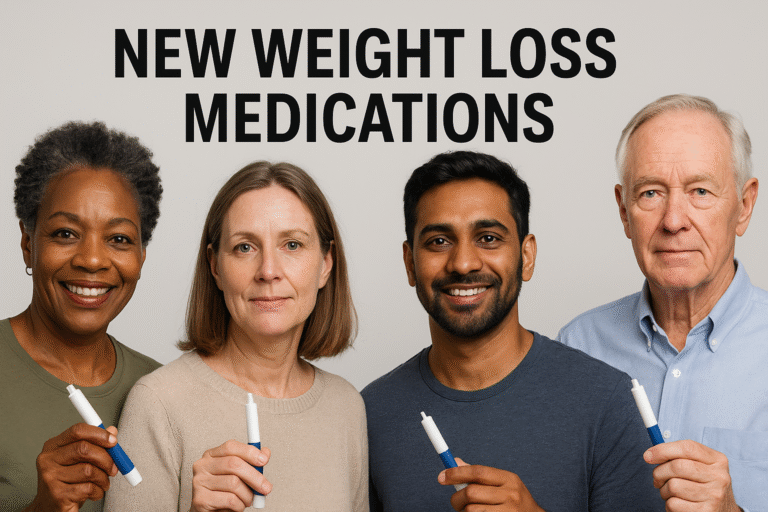
We now offer Private Weight Loss Treatments

The Next Wave of Weight Loss Drugs

PRIVATE SERVICES · 1 minute read
Rahul Puri
Written by Rahul PuriSuperintendent Pharmacist, MPharm, PgDip, PgCert IP
Medically reviewed 9 October 2026
Share:
Stay informed

Get our latest weight-loss and health guides straight to your inbox.

Weight-management research includes different mechanisms, formulations and stages of development. Some programmes remain investigational; others have reached UK authorisation. A promising trial, a licence, NHS access and individual suitability are separate questions.

Evidence update: 9 October 2026. This overview explains six programmes and how to interpret their claims.

The sections below distinguish current authorisation from ongoing research. Puri Pharmacy does not offer access to research peptides.

Share:
Stay informed

Get our latest weight-loss and health guides straight to your inbox.

This post has been verified by a clinical specialist.

Verified by Rahul Puri on 16 June 2025

South Asian man self-administering a Retatrutide style injection using a beige and blue pen injector, representing personal use of experimental triple-action weight loss medication

A “Triple Hormone” Weight Loss Shot

Retatrutide

Retatrutide: triple-receptor research

Retatrutide targets GIP, GLP-1 and glucagon receptors. In Lilly’s May 2026 TRIUMPH-1 report, the 12 mg group had mean weight reduction of 25.0% versus 3.9% with placebo at 80 weeks under the treatment-regimen analysis, in adults without diabetes. The efficacy analysis answered a different question and produced a different estimate.

This is promising, but a trial average is not an individual prediction or a head-to-head ranking against other medicines. Adverse events, discontinuations and longer-term outcomes matter. The cited report describes retatrutide as investigational; it does not provide a confirmed UK launch date.

TRIUMPH-1 source · Rahul’s retatrutide guide.

Illustration of a magnifying glass over research reports
Look beyond the headline to the study design and analysis.
Woman shown with a glowing stomach illustration, standing beside a healthy plate of food, next to a pill and injection pen—representing how Amycretin targets hunger through two hormones.

Dual-Action (GLP-1 + Amylin) Therapy

Amycretin

Amycretin / zenagamtide: GLP-1 and amylin

Amycretin, now also called zenagamtide, combines GLP-1 and amylin receptor activity. Novo Nordisk’s 2026 update describes both oral and injectable development and the start of the AMAZE phase 3 obesity programme.

The formulation matters: oral and injectable results cannot be treated as interchangeable. Check the study population, dose, length of follow-up and adverse events before interpreting early weight-loss findings. A programme entering phase 3 does not establish a launch date.

Source: Novo Nordisk Q2 2026 research update.

A Powerful Combo of Two Drugs

CagriSema

CagriSema: a combination programme

CagriSema combines cagrilintide, an amylin receptor agonist, with semaglutide. Novo Nordisk’s September 2026 announcement reports additional phase 3 results and describes it as investigational.

REIMAGINE 5 compared specified CagriSema doses with tirzepatide 5 mg in adults with type 2 diabetes. Its findings cannot establish superiority over every tirzepatide dose or in everyone without diabetes. REDEFINE 9 used a different population and placebo comparison. Read each trial separately rather than combining the most favourable numbers.

Source: 21 September 2026 CagriSema announcement.

Young woman taking a weight loss pill with water, representing the emerging pill-based weight loss medications like CagriSema.

A Weight Loss Pill from Eli Lilly

Orforglipron

Orforglipron: UK authorisation has occurred

The MHRA authorised orforglipron on 10 August 2026 for specified adult weight-management and type 2 diabetes indications. It is an oral GLP-1 receptor agonist and a prescription-only medicine. Describing it simply as a future treatment awaiting approval is now out of date.

Authorisation, NHS access, supply through a particular provider and clinical suitability are different matters. The MHRA announcement lists gastrointestinal side effects and ongoing safety monitoring. This article is not an offer to supply it or a recommendation to change treatment.

Source: MHRA authorisation announcement.

Illustration of balancing research evidence
Balance possible benefits against adverse effects and remaining uncertainty.
Young woman administering an injection into her abdomen using a KwikPen-style injector, showing self-use of weight loss medication.

A Once-a-Month Weight Loss Injection

MariTide

MariTide: studying less frequent injections

MariTide is a peptide–antibody conjugate combining GLP-1 receptor activation with GIP receptor antagonism. Amgen reports that it is being studied in the phase 3 MARITIME programme.

Its phase 2 research studied monthly or less frequent administration and reported substantial weight reductions. Gastrointestinal effects and treatment discontinuations were relevant. A less frequent schedule may be convenient, but it does not by itself prove better adherence, safety or long-term outcomes than other approaches.

Sources: 2026 programme overview and phase 2 report.

Smiling man holding up a blister pack of pills, symbolising the daily pill format of orforglipron and future oral GLP-1 medications.

Another Promising Daily Pill

GSBR-1290

GSBR-1290 / aleniglipron: oral small-molecule research

Aleniglipron is an investigational oral, nonpeptide GLP-1 receptor agonist. Structure Therapeutics’ March 2026 ACCESS II announcement reported phase 2 results at 44 weeks, including placebo-adjusted mean weight reductions of 16.3% and 16.0% in the two specified dose groups.

Placebo-adjusted reduction is the difference between groups, not the total reduction experienced in the treatment group. Sponsor-reported topline findings need that context, plus adverse-event and discontinuation data. Plans for further trials are not proof of approval or a UK availability date.

Source: ACCESS II announcement.

A practical way to read the next headline

  1. Identify who took part and whether the results apply to your question.
  2. Check the comparator, follow-up and how missing or discontinued treatment was handled.
  3. Read adverse effects and withdrawals alongside the weight result.
  4. Check UK regulatory status separately from trial announcements.

Rahul Puri, pharmacist

Ask Rahul

Rahul Puri | Pharmacist

Evidence, safety and your next step

What makes a promising result worth following?

A meaningful benefit in a well-described trial deserves attention. I also want to know who benefited, who stopped treatment, what the comparator was and what remains uncertain. Those details are how we turn an exciting headline into useful understanding.

×
Your Cart
Cart is empty.
Fill your cart with amazing items
Shop Now
£0.00
Shipping & taxes may be re-calculated at checkout
£0.00
Secure Secure Checkout
Fast Shipping
Returns Easy Returns