Family History of Osteoporosis: Does a Parent’s Hip Fracture Matter?


Get our latest weight-loss and health guides straight to your inbox.
A family history of osteoporosis matters, especially if a parent has broken a hip. It can increase your own risk, but it does not mean you will inevitably develop osteoporosis or have a fracture.
The NHS identifies a parent’s hip fracture as an important risk factor. The useful next step is to discuss that history alongside your age, previous fractures, medicines and other health factors.
PURI PHARMACY · HILLINGDON & SOUTHALL
Osteoporosis in the family? Understand your own bone health.
Understand what a bone-health assessment can tell you and whether it may be suitable for you.
£89 · Around 20 minutes
Risk-factor review, Bindex ultrasound measurement and your result explained.
Suitability is assessed individually. Bindex screening does not replace a clinically required DXA scan.

Does osteoporosis run in families?
Genes contribute to your skeleton’s size and strength. The Royal Osteoporosis Society explains that either parent’s history can matter. This includes both your father and your mother.
Family history is for risk assessment, not diagnosis. Your circumstances may differ from your relative’s, and you can support your bone health in practical ways, even though you cannot change your family history.
Why does a parent’s hip fracture deserve attention?
A parent may have broken a hip without ever being told they had osteoporosis. The Royal Osteoporosis Society’s Bone Check FAQs explain why asking about hip fractures can be more informative than asking only about a diagnosed osteoporosis.
Tell your healthcare professional which parent was affected, roughly how old they were, and what happened, if you know. A hip fracture after a simple fall is useful detail. If the circumstances are unclear, say so rather than guessing.
What information should you gather?
| Information | What to note |
|---|---|
| Who was affected? | Your mother, father or another relative. Be specific rather than writing only “family history”. |
| What happened? | A confirmed osteoporosis diagnosis, a hip fracture or another broken bone. |
| Age and circumstances | Approximate age and whether the fracture followed a minor fall or a major accident, if known. |
| Your own history | Previous fractures, menopause (where relevant), medicines, conditions, and existing scan results. |
| What you do not know | Uncertain details are acceptable. You do not need to obtain a relative’s private medical records. |
When should you speak to your GP?
The Royal Osteoporosis Society advises people over 50 whose parents had osteoporosis or broken bones to discuss fracture-risk assessment with their doctor. Younger people may also need advice depending on their own history.
Mention any fracture you have had after a minor injury. Unexplained back pain, height loss or a change in posture also deserve medical discussion. Do not wait for routine pharmacy screening if you need investigation of symptoms or a suspected fracture.
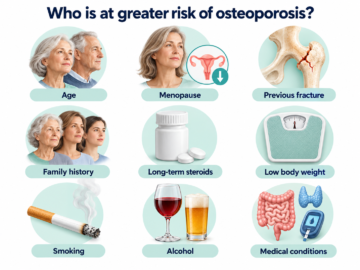
Family history becomes particularly useful when considered with other factors, such as low body weight, menopause, certain medical conditions or long-term medicines affecting bone strength. Do not stop prescribed medicines because you are concerned about osteoporosis.
Does family history mean you need a DXA scan?
Not automatically. A clinician considers your overall fracture risk and whether a scan would help with diagnosis or care decisions.
DXA, sometimes written DEXA, uses low-dose X-rays to measure bone mineral density, usually at the hip and spine. Keep a clinically required DXA referral, even if you have had a reassuring screening result elsewhere.
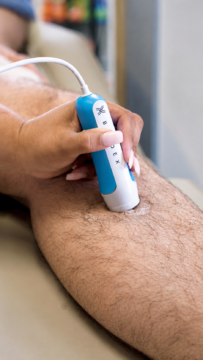
Bindex uses ultrasound at the shinbone to produce a Density Index that helps assess osteoporosis probability. It is a different measurement. Our Bindex versus DXA guide explains how their roles differ.
Where can a Puri Pharmacy assessment fit?
If you are considering a first bone-health assessment, tell the team about your family history and any existing investigations. We can discuss whether our in-person Bindex assessment suits your circumstances.
The assessment combines relevant risk-factor review with the ultrasound measurement and an explanation of the result and next steps. Further investigation may still be needed. Screening does not diagnose an acute fracture or replace an existing osteoporosis care plan.
For appointment details, read our Bindex assessment guide.
What can you do if you cannot change your family history?
The NHS bone-health guidance recommends regular activity, appropriate weight-bearing and resistance exercise, good nutrition, stopping smoking and limiting alcohol.
- Think about calcium and vitamin D intake rather than buying supplements simply because a relative has osteoporosis.
- Choose exercise suitable for your health and ability. If you have osteoporosis, a previous fracture or persistent pain, ask for advice before starting a new programme.
- Bring your medicines list and any previous scan reports to a review.
- Ask what your assessment means for you and whether any follow-up is needed.

Frequently asked questions
Does my father’s hip fracture count?
Yes. A hip fracture in either parent is relevant. Do not leave it out because osteoporosis is sometimes thought of as a condition affecting only women.
What if my parent never had an osteoporosis diagnosis?
Still mention the hip fracture. The absence of a diagnosis does not make the fracture history irrelevant. Give the details you know and identify any uncertainty.
What if only my grandmother had osteoporosis?
Tell your clinician, but distinguish a grandparent from a parent. Don’t treat different family histories as identical, and keep your own risk factors in mind.
Can a normal screening result cancel out family history?
No. A measurement is one part of the picture. Family history and your medical circumstances still need consideration, and a screening result does not guarantee you will not have a fracture.
Understand your next step in Hillingdon or Southall
PURI PHARMACY · HILLINGDON & SOUTHALL
Ready to discuss your bone health?
Explore our assessment in Hillingdon or Southall. Tell the team about previous fractures, current medicines and any existing referrals.
£89 · Around 20 minutes
Risk-factor review, Bindex ultrasound measurement and your result explained.
Suitability is assessed individually. Bindex screening does not replace a clinically required DXA scan.