What Is a Bindex® Bone Health Assessment? UK Guide

Get our latest weight-loss and health guides straight to your inbox.
If you have recently heard about Bindex® bone health assessments, you may be wondering what the technology actually measures and how it differs from a conventional hospital bone-density scan.
Bindex is a portable ultrasound technology designed to help assess a person’s probability of osteoporosis. Unlike DXA scanning, it does not use X-rays.
At Puri Pharmacy, Bindex forms part of our £89 in-store Bone Health & Osteoporosis Risk Assessment in Hillingdon and Southall.
This guide explains exactly what the technology does, and, just as importantly, what it does not do.
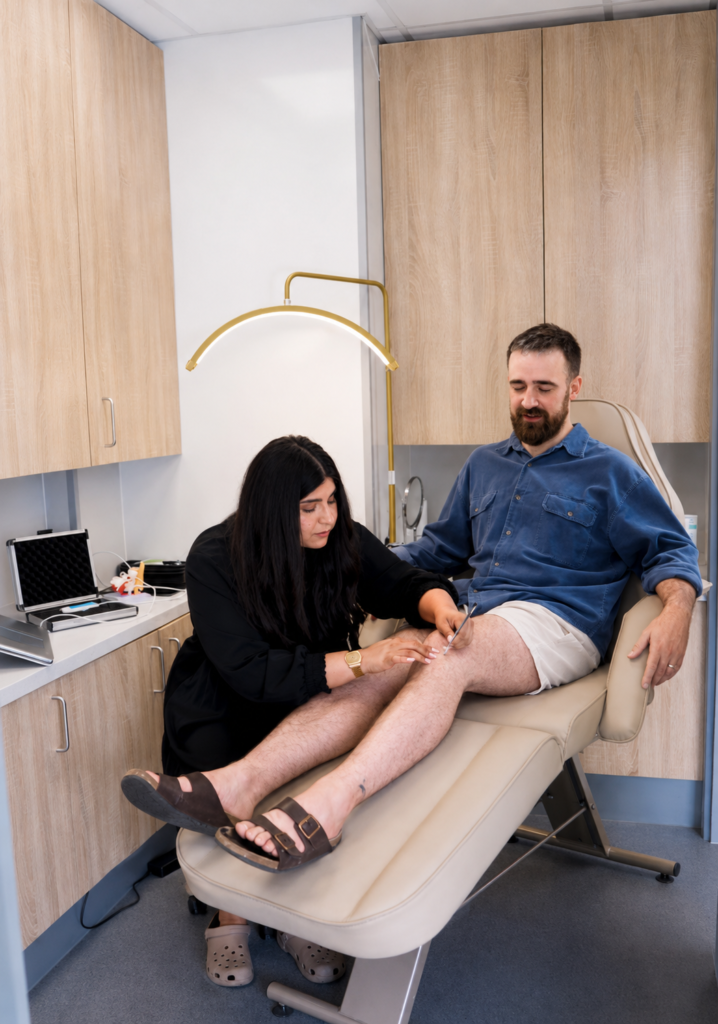
How does Bindex work?
Bindex uses pulse-echo ultrasound.
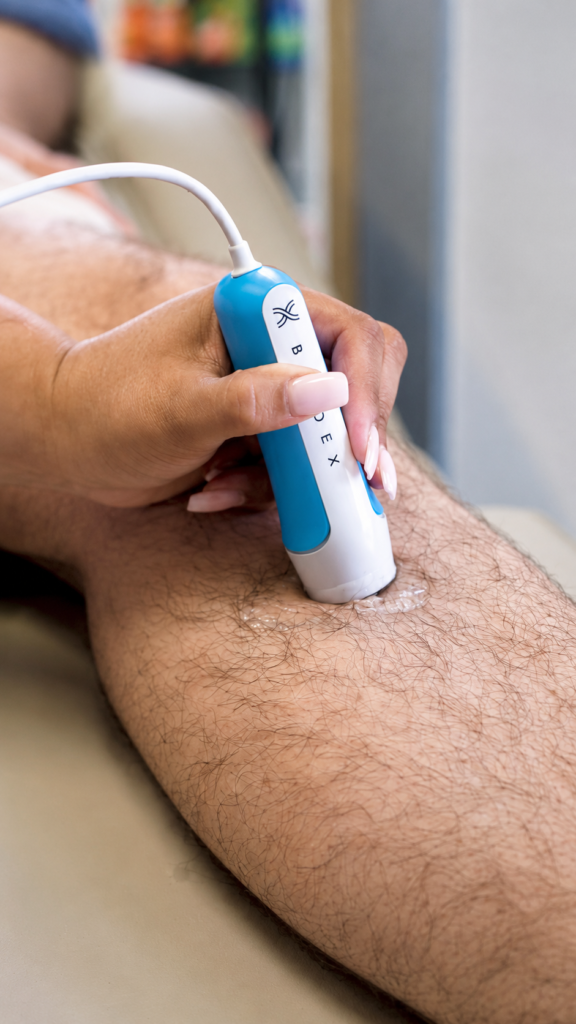
A measurement is taken at the upper part of the tibia in the lower leg. Ultrasound echoes are used to estimate the thickness of the cortical bone.
The Bindex software then combines this information with characteristics such as the person’s age, height, and weight to calculate a Density Index.
NICE describes the Density Index as an estimate of hip bone mineral density that can help stratify osteoporosis risk.
In practical terms, Bindex helps answer:
Is this person’s result consistent with a lower or higher probability of osteoporosis, and does it suggest further investigation is needed?
For a technical explanation of the technology, see NICE’s briefing on Bindex.
Does Bindex involve radiation?
No.
Bindex uses ultrasound rather than X-rays, so there is no ionising radiation from the Bindex measurement.
That is one practical difference between Bindex and DXA.
DXA is also considered a very low-radiation investigation, but it uses low-dose X-rays to measure bone mineral density.
Is Bindex painful?
The measurement is non-invasive.
We apply ultrasound gel to the measurement area on the lower leg, then use the handheld transducer to obtain the reading.
NICE’s technical description states that the Bindex measurement itself typically takes under 15 minutes. At Puri Pharmacy, we allow around 20 minutes for the wider appointment so there is time to discuss your history and explain the result.
What does a Bindex result tell you?
A Bindex result is designed to provide information about your probability of osteoporosis.
It is not simply a yes/no home screening test, and you should consider the result alongside the person’s clinical history and risk factors.
These might include age, menopause, previous fractures, family history, smoking, low body weight, systemic steroid use and conditions associated with reduced bone strength.
This matters because bone strength cannot be understood from one measurement alone.

Is Bindex the same as a DEXA scan?
No.
A DXA, sometimes written DEXA, scan measures bone mineral density, commonly at the hip and lumbar spine.
DXA results may be expressed using a T-score. In appropriate adults, this helps clinicians classify bone density as normal, within the osteopenia range or within the osteoporosis range.
Bindex does not perform the same measurement.
It uses tibial ultrasound and calculates its own Density Index to help determine osteoporosis probability.
The two technologies should therefore not be treated as interchangeable.
Why would someone choose a Bindex assessment?
For someone who wants to understand their bone health proactively, one advantage is accessibility.
The assessment can be carried out in a community clinical setting without an imaging department.
It is particularly relevant to people who have started thinking about their bone health because of age, menopause, family history or another risk factor but may not previously have had a formal assessment.
The result can then support an informed conversation about whether lifestyle changes alone are appropriate or whether formal clinical investigation is needed.
Will I still need a DXA scan?
Possibly.
That depends on your result and your overall clinical risk.
NICE recommends formal fracture-risk assessment using validated tools such as FRAX or QFracture in appropriate adults. Bone mineral density may then be measured using DXA when indicated.
If a Bindex assessment identifies a result that warrants further investigation, the appropriate next step may therefore be a discussion with your GP or another suitable healthcare professional.
What happens during a Puri Pharmacy assessment?
Our Bone Health & Osteoporosis Risk Assessment combines the Bindex measurement with a wider discussion about your bone health.
We review relevant risk factors, perform the ultrasound assessment, explain the result and discuss appropriate next steps.
The complete appointment takes around 20 minutes and costs £89.
The service is available from our pharmacies in Hillingdon and Southall, serving surrounding areas including Uxbridge, Ickenham, Ruislip, Hayes, Ealing, Hanwell, Greenford and West Drayton.