Monitoring progress with Wegovy: your guide

TL;DR:
- Tracking progress on Wegovy requires monitoring weight, waist circumference, appetite, mood, and energy, not just the scale. Early success includes losing 10% of body weight by week 16 and noting improvements in mobility and mental well-being, with consistency being key. Regular professional support helps interpret results, manage doses, and avoid common measurement mistakes.
Starting Wegovy is a significant step, but knowing whether it’s actually working is where many people feel uncertain. Monitoring progress with Wegovy goes well beyond watching the number on the scale drop each week. True success on this medication shows up in your appetite, your energy, your mood, and your physical ability, not just your trouser size. This guide gives you a practical, honest framework for tracking Wegovy results across every dimension that matters, so you can interpret what you’re experiencing, avoid common mistakes, and make confident, informed decisions throughout your treatment.
Table of Contents
- Key takeaways
- Monitoring progress with Wegovy: what to track and why
- How to track your Wegovy results week by week
- Common mistakes when measuring changes with Wegovy
- Realistic milestones for Wegovy weight loss progress
- My honest take on tracking progress
- Start your Wegovy journey with proper support
- FAQ
Key takeaways
| Point | Details |
|---|---|
| Use multiple measures | Track weight, waist circumference, energy, mood, and appetite alongside the scale. |
| Set a clear baseline | Record starting data before or at the point of your first injection for meaningful comparisons. |
| Expect early response signals | Losing 10% of body weight by week 16 is a strong predictor of long-term success. |
| Plateaus are normal | Metabolic adaptation slows the scale; resistance training helps protect muscle and continue fat loss. |
| Celebrate non-scale wins | Improvements in stamina, sleep, and mood are genuine markers of Wegovy effectiveness. |
Monitoring progress with Wegovy: what to track and why
Before you can measure progress, you need a clear starting point. Many people begin their Wegovy journey without recording any baseline data, which makes it almost impossible to recognise genuine change over time. Taking stock of where you are at the outset gives you something concrete to compare against as weeks and months pass.
The measurements worth recording at the start are:
- Weight: Weigh yourself at the same time of day, on the same scales, ideally first thing in the morning without clothes.
- BMI: Your body mass index gives a rough guide, but it tells an incomplete story on its own.
- Waist circumference: This is often a better indicator of metabolic health than weight alone. Measure at the level of your navel.
- Body composition: If you have access to a body composition scale or a DEXA scan, record your fat percentage and lean mass. This matters more than most people realise.
- Subjective markers: Note your appetite on a scale of 1 to 10, your typical daily energy level, your mood, and any existing conditions such as joint pain or breathlessness.
The table below summarises the main tools you’ll use for Wegovy success monitoring and what each one actually captures.
| Tool | What it measures | How often to use |
|---|---|---|
| Digital scales | Body weight | Weekly, same day and time |
| Measuring tape | Waist, hip, thigh circumference | Monthly |
| Food diary or app | Caloric intake, eating patterns | Daily |
| Symptom journal | Side effects, appetite, energy | Daily for first 3 months |
| Body composition scale | Fat mass vs lean mass | Monthly if available |
| GP or pharmacy check-in | Blood pressure, blood glucose | Every 3 months |
Scheduling regular check-ins with your healthcare provider is not optional. Proper dosing and technique are critical to maximising the medication’s effectiveness, and a professional review helps you interpret whether your results are on track.
How to track your Wegovy results week by week
Once your baseline is recorded, tracking Wegovy results becomes a weekly habit. Consistency matters far more than precision. Here is a practical step-by-step process to follow throughout your treatment.
- Weigh in once per week. Daily weighing amplifies noise from water retention, hormones, and digestion. Weekly gives you the signal. Record the number without judgement.
- Note appetite changes. Wegovy works by reducing hunger. If you’re still eating the same quantities without noticing any shift in your desire for food, record that too. It’s useful clinical information.
- Log your injection day and dose. The dose escalation schedule spans roughly five months, starting at 0.25 mg and building to a maintenance dose of 2.4 mg. Recording exactly where you are in this process helps you contextualise any side effects or plateaus.
- Record side effects honestly. Nausea, fatigue, and digestive discomfort are most intense after dose increases. Note the severity, when they appear, and how long they last.
- Measure your waist once a month. Body shape changes often precede changes on the scale, particularly when fat is redistributing.
- Write one non-scale observation per week. Did you walk further without getting tired? Sleep better? Feel less joint pain? These matter enormously for Wegovy effectiveness feedback.
- Review your journal monthly. Look at trends, not individual data points. Progress is rarely linear.
Pro Tip: Schedule your weekly injection on a Friday evening if your working week is Monday to Friday. Side effects are most intense in the 24 to 48 hours after the injection, meaning you can rest during the weekend rather than managing nausea at your desk.
Real progress often looks messy close up. A personal account of incremental loss over months confirms what the data also shows: mental resilience and consistent monitoring matter as much as the medication itself.
Common mistakes when measuring changes with Wegovy
Even people who are diligent about tracking make avoidable errors. Knowing what they are before you hit them is genuinely useful.
Fixating on the scale alone is the most common. Weight fluctuates for dozens of reasons that have nothing to do with fat loss. Retaining water after a salty meal can show a two-kilogram gain overnight. Judging your Wegovy weight loss progress by a single weigh-in is like judging a film by one frame.
Ignoring muscle mass is more serious than most people realise. Weight loss on Wegovy includes lean muscle at a rate of 20 to 40% of total weight lost if no resistance training is done. Muscle loss slows your metabolism and increases your likelihood of hitting a plateau. Tracking body composition, not just body weight, gives you the full picture.
The other pitfalls worth watching for:
- Over-restricting food: Very low calorie intake accelerates muscle loss and can worsen side effects.
- Over-exercising during dose escalation: Intensive exercise when you’re managing nausea is not a good combination. Gentle movement is enough in the early stages.
- Dismissing a plateau as failure: Weight loss plateaus are a result of metabolic adaptation and reduced energy needs as your body becomes smaller. They are not a sign that Wegovy has stopped working.
- Ignoring persistent side effects: Nausea lasting more than a week at any given dose, or symptoms that feel severe, should prompt a conversation with your pharmacist or GP.
“If the scale hasn’t moved for three weeks but your waist is smaller, your energy is better, and you’re eating noticeably less, you are progressing. The scale is one instrument in an orchestra.”
Realistic milestones for Wegovy weight loss progress
One of the most important things you can do for your long-term motivation is set realistic expectations. The research on Wegovy is genuinely encouraging, but it is rarely as fast or as simple as the headlines suggest.
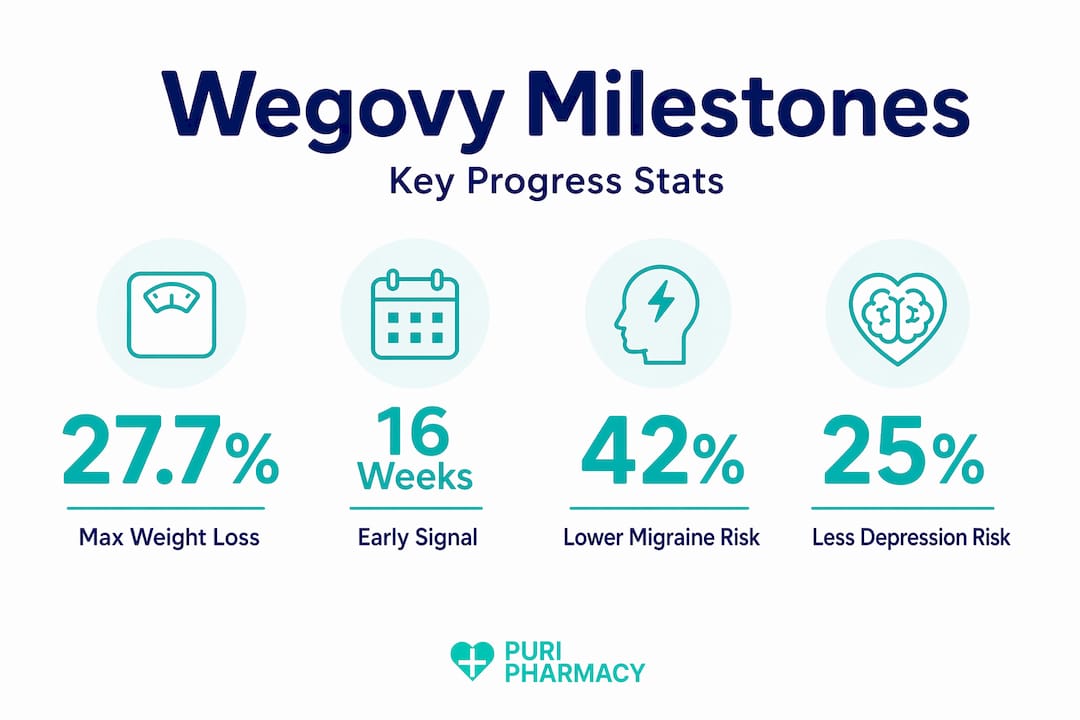
Early responders, roughly 25% of patients at higher doses, can achieve up to 27.7% body weight loss over approximately 18 months. That is substantial. But the majority of people experience a slower, steadier trajectory, and that is still a meaningful clinical result.
Losing 10% or more of body weight by week 16 is considered a strong early responder signal and a predictor of continued progress. If that hasn’t happened yet at week 16, it does not mean the medication is failing. Slower responders still achieve clinically meaningful results.
| Milestone | Timeframe | What to monitor |
|---|---|---|
| Initial appetite reduction | Weeks 1 to 4 | Portion size, cravings, meal satisfaction |
| First noticeable weight loss | Weeks 4 to 8 | Scale weight, energy levels |
| Improved mobility and stamina | Months 2 to 4 | Step count, breathlessness, joint comfort |
| Waist circumference reduction | Months 2 to 5 | Monthly measurements |
| Sustained weight loss | Months 4 to 18 | Trend line, body composition |
| Maintenance dose integration | Month 5 onwards | Lifestyle habits, mood, weight stability |
Beyond the scale, Wegovy’s benefits include 42 to 45% lower migraine risk and 25% lower depression risk. Improvements in mobility and physical function are also well documented. Monitoring quality of life metrics like mood, energy, and mobility is central to evaluating real success on this medication.

Wegovy works best as part of a broader lifestyle approach. Nutrition, sleep, and behaviour change all influence how your body responds. Holistic weight management including dietary support and behaviour change produces better outcomes than medication alone. If you are looking for structured support alongside your medication, the NHS digital weight management programme is worth exploring as a complementary resource.
My honest take on tracking progress
In my experience, the people who get the most from Wegovy are the ones who stop treating it like a crash diet and start treating it like a long-term health intervention. The mindset shift is real, and it takes time.
What I have seen repeatedly is that the scale creates unnecessary distress when used as the only measure. Someone reduces their waist by five centimetres, sleeps through the night for the first time in years, and stops having cravings by mid-afternoon. They feel genuinely different. Then they weigh themselves on a Thursday and the number is the same as last week, and everything feels like a failure. That disconnect is avoidable if you track the full picture from the start.
I also think people underestimate how much emotional variability is part of this process. There are weeks where progress feels invisible. There are weeks where a side effect knocks your confidence. That is normal. What helps is having a written record you can look back on. When you feel stuck, your journal from four weeks ago will often remind you how far you have actually come.
My suggestion: review your Wegovy progress journal monthly rather than obsessing over weekly numbers. Look for trends across appetite, weight, energy, and mood together. That pattern is far more informative than any single data point. And when the scale plateaus, prioritise resistance training rather than eating less. Protecting your muscle mass is what keeps fat loss moving forward.
— R
Start your Wegovy journey with proper support
If you are considering Wegovy or already partway through your treatment, having professional oversight makes a tangible difference to your results. Puripharmacy offers Wegovy weight loss injections through a private prescribing clinic in west London, with clinical support throughout your treatment.

Our team can help you establish your baseline, interpret your results, manage dose escalation, and adjust your approach when you hit a plateau. Rather than figuring it out alone using a tracking app and a YouTube video, you get direct access to professionals who understand the medication and can give you personalised guidance at each stage. Whether you are just starting out or questioning whether Wegovy is working for you, a consultation with Puripharmacy is a practical first step. Visit our Wegovy service page to learn more or book your appointment.
FAQ
How do I know if Wegovy is working?
Wegovy is working if you notice reduced appetite, steady weight loss over several weeks, and improvements in energy or mobility. Losing 10% of body weight by week 16 is a strong early indicator of significant longer-term results.
How often should I weigh myself on Wegovy?
Weigh yourself once a week at the same time and on the same scales. Daily weighing picks up too much normal fluctuation to be useful, and it can cause unnecessary anxiety about short-term changes that are not related to fat loss.
Why has my Wegovy weight loss stalled?
Weight loss plateaus happen because your metabolism adapts as you lose weight and your body becomes smaller. Plateaus are a result of metabolic adaptation and are not a sign of treatment failure. Adding resistance training to protect muscle mass is the most effective response.
What should I record in a Wegovy progress journal?
Record your weekly weight, monthly measurements, daily appetite rating, side effects, injection dose, and at least one non-scale observation each week such as energy levels, sleep quality, or changes in physical ability.
Can Wegovy improve things other than my weight?
Yes. Clinical data shows Wegovy is associated with reduced migraine and depression risk alongside improvements in mobility and physical function. Tracking these quality of life changes is an important part of Wegovy success monitoring.