How to lose weight safely and sustainably

TL;DR:
- Effective weight loss involves creating a gradual, sustainable calorie deficit through a balanced diet of whole foods and regular physical activity. Setting specific, measurable goals and building habits gradually support long-term success, while avoiding fad diets and quick fixes prevents rebound weight gain. Professional support and personalized plans enhance the likelihood of maintaining healthy weight loss over time.
Losing weight is defined as achieving a sustained calorie deficit through a balanced diet and regular physical activity, combined with gradual habit changes you can maintain long term. The NHS, NIDDK, and Harvard Health all converge on the same core principle: there is no shortcut that works reliably. What does work is a structured, realistic plan that fits your life. This article gives you exactly that, drawing on the best available evidence to help you shed pounds safely, protect muscle, and keep the weight off for good.
What is a healthy and realistic weight loss target?
A safe weight loss pace is 1 to 2 lb (0.5 to 1 kg) per week. That rate is slow enough to preserve muscle mass and maintain adequate nutrition, yet fast enough to produce visible results within weeks. Harvard Health confirms that losing more than 2 lb weekly risks muscle loss and nutrient deficiencies, and can actually lower your resting metabolism, making future weight regain more likely.
A practical starting target is losing 5 to 10% of your current body weight within six months. For someone weighing 90 kg, that is 4.5 to 9 kg. This range is clinically meaningful: it reduces blood pressure, improves blood sugar control, and lowers the risk of type 2 diabetes, all before you reach an “ideal” weight. The NIDDK’s Diabetes Prevention Program uses exactly this target because it is achievable and motivating.
Setting a specific, measurable goal matters more than most people realise. Vague intentions like “I want to get fitter” produce far weaker results than concrete targets such as “I will lose 5 kg by September by walking 30 minutes five days a week and cutting out sugary drinks.” Specificity gives you something to track and adjust.
Key principles for target setting:
- Aim for 1 to 2 lb (0.5 to 1 kg) per week as your weekly benchmark
- Set a six-month goal of 5 to 10% of your starting body weight
- Write your goal down with a specific date and measurable milestone
- Weigh yourself at the same time each week, not daily, to track trends rather than fluctuations
- Adjust your target if you hit a plateau rather than abandoning the plan entirely
Pro Tip: Weigh yourself on the same day each week, first thing in the morning, after using the bathroom. Weekly averages are far more informative than daily readings, which swing with hydration and digestion.
How to create a sustainable calorie deficit through diet
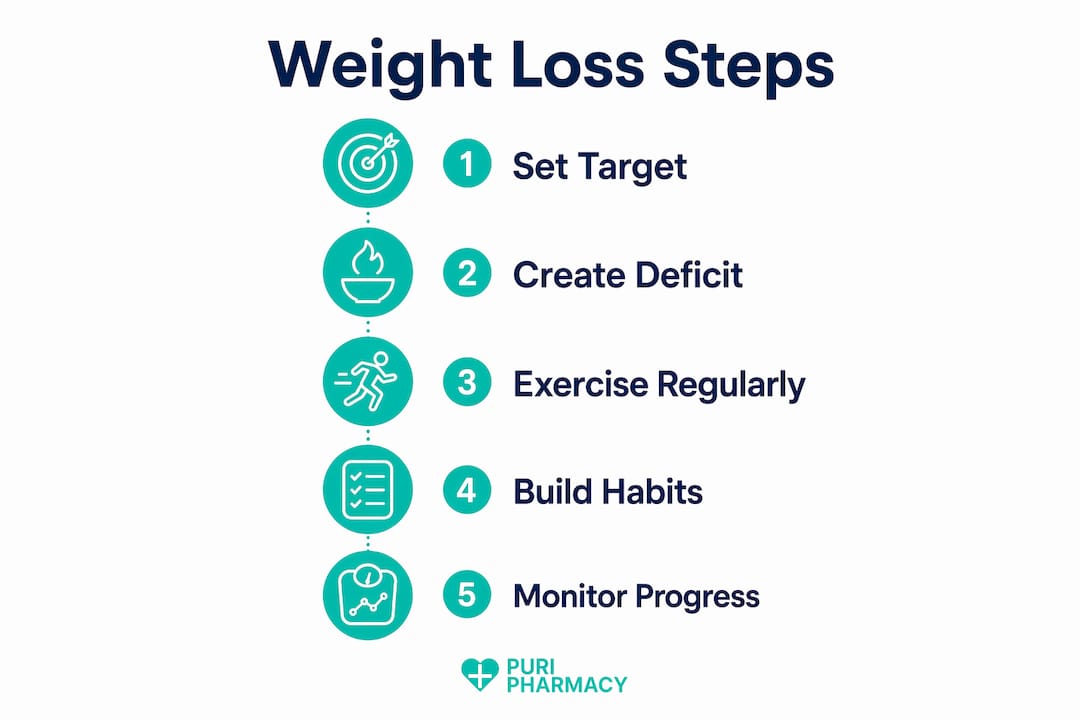
Achieving a 500 to 750 calorie daily deficit below your energy expenditure is the dietary engine of weight loss. That deficit does not require starvation. It requires smarter food choices, better portion awareness, and a weight loss diet plan built around whole, filling foods.
The foundation of any effective eating plan is whole foods: vegetables, fruits, whole grains, lean proteins such as chicken, fish, eggs, and legumes, and healthy fats from sources like olive oil, avocado, and nuts. These foods are nutrient-dense and high in fibre, which means they keep you fuller for longer on fewer calories. Processed foods, by contrast, are engineered to be easy to overeat and offer little satiety per calorie.
Practical steps to build your eating plan:
- Start with one change. Replace sugary drinks (fizzy drinks, fruit juice, flavoured coffees) with water or unsweetened tea. This single swap can eliminate 200 to 400 calories per day without any sense of deprivation.
- Read food labels. Check the per-100g figures for calories, saturated fat, sugar, and salt. The traffic light system on UK packaging makes this quick. Choosing the amber or green option over red consistently adds up.
- Control portions without weighing everything. Use your hand as a guide: a palm-sized portion of protein, a fist of carbohydrates, two fists of vegetables, and a thumb of fat per meal.
- Eat without distractions. NHS Inform highlights that distracted eating leads to consuming more without noticing. Sit at a table, away from screens, and eat slowly.
- Plan meals ahead. Decide what you will eat for the week on Sunday. Batch-cook grains, proteins, and roasted vegetables so healthy choices are always the easiest option.
Pro Tip: Swap white rice or pasta for cauliflower rice or courgette noodles once or twice a week. You will cut roughly 150 calories per meal without reducing volume, which matters enormously for satiety.
Building habits gradually is more sustainable than overhauling everything at once. Start with one or two changes, master them, then add the next. This approach avoids the burnout that derails most diets within the first month.
What role does physical activity play in losing weight?
Exercise is not the primary driver of weight loss. Diet creates the deficit. But physical activity is the primary driver of keeping weight off, protecting muscle, and improving every health marker beyond the number on the scale. The NIDDK recommends at least 150 minutes per week of moderate-intensity aerobic activity for weight loss, rising to 300 minutes per week for long-term maintenance.

The best workouts for fat loss are the ones you will actually do consistently. Brisk walking, cycling, swimming, and dancing all count as moderate aerobic activity. You do not need a gym membership. A 30-minute brisk walk five days a week meets the 150-minute target and costs nothing. NIDDK advises setting specific goals such as “walk for 20 minutes on Monday, Wednesday, and Friday” rather than the vague intention to “be more active.”
Strength training deserves equal attention. Muscle tissue burns more calories at rest than fat tissue, so preserving and building muscle through resistance exercises two or more days per week supports your metabolism throughout the fat loss process. Bodyweight exercises like squats, press-ups, and lunges require no equipment and can be done at home.
Key points for building your activity plan:
- Target 150 minutes per week of moderate aerobic activity to start losing belly fat and improving cardiovascular health
- Add muscle-strengthening exercises at least twice a week, targeting all major muscle groups
- Break activity into 10-minute blocks if a full 30-minute session feels unmanageable at first
- Track your activity with a free app like Google Fit or a basic pedometer to stay accountable
- Increase duration or intensity gradually, roughly 10% per week, to avoid injury and build fitness progressively
Physical activity also delivers health benefits independent of weight loss, including better mood, reduced anxiety, improved sleep, and stronger cardiovascular markers. These benefits matter even during weeks when the scale does not move.
How to build habits and stay motivated
Motivation is unreliable. Habits are not. The most effective weight loss strategies are built on systems that remove the need for daily willpower. A quality weight loss programme combines reduced-calorie eating with increased activity, personalised goal-setting, and ongoing monitoring. All three elements work together.
Here is a practical habit-building sequence:
- Track what you eat for two weeks before making any changes. Most people underestimate their calorie intake by 20 to 40%. Awareness alone often prompts better choices.
- Schedule your exercise like a meeting. Put it in your calendar. Treat it as non-negotiable. People who exercise at the same time each day are significantly more consistent than those who fit it in when convenient.
- Manage stress actively. Chronic stress raises cortisol, which increases appetite and promotes fat storage around the abdomen. Practices like a 10-minute walk, breathing exercises, or even five minutes of quiet reading reduce cortisol measurably.
- Prioritise sleep. Poor sleep disrupts ghrelin and leptin, the hormones that regulate hunger and fullness. Seven to nine hours per night is not optional for effective fat loss.
- Seek social support. Telling a friend, joining a group, or working with a healthcare professional significantly improves adherence. Regular self-monitoring of weight and lifestyle is a key behaviour for long-term success.
Expect setbacks. A bad week is not a failed plan. It is data. Review what happened, adjust one variable, and continue. Self-compassion is not softness. It is the evidence-based response to imperfection that keeps people in the game long enough to succeed.
Common pitfalls and how to troubleshoot your plan
Quick-fix and fad diets are restrictive, typically ineffective long term, and often lack essential nutrients. They work briefly because they create a large calorie deficit, but they are unsustainable and frequently trigger rebound weight gain. The NHS advises avoiding them entirely in favour of balanced, gradual eating changes.
Weight loss plateaus are normal and expected. As your body weight decreases, your calorie needs decrease too. A plan that produced a 500-calorie deficit at 90 kg may produce only a 200-calorie deficit at 80 kg. Adjusting goals and persisting through plateaus is what separates people who maintain their results from those who regain.
Common pitfalls to watch for:
- Relying on exercise alone without addressing diet (exercise burns fewer calories than most people assume)
- Setting all-or-nothing goals that collapse after one missed day
- Eating “healthy” foods in excessive quantities (nuts, avocado, and olive oil are nutritious but calorie-dense)
- Stopping self-monitoring once initial progress stalls
- Neglecting maintenance. 300 minutes per week of moderate activity is the evidence-based target for preventing weight regain after loss
“Flexibility and persistence matter more than perfection. Adjusting your plan after a setback is not failure. It is the strategy.”
If you have been following a consistent plan for six to eight weeks without progress, consult a healthcare professional. Thyroid function, medication side effects, and hormonal factors can all affect weight loss and are worth investigating.
Key takeaways
Effective weight loss requires a sustained calorie deficit through whole-food eating, at least 150 minutes of weekly activity, and gradual habit changes that replace willpower with reliable systems.
| Point | Details |
|---|---|
| Set a specific target | Aim to lose 5 to 10% of body weight in six months, at a rate of 1 to 2 lb per week. |
| Build your diet on whole foods | Prioritise vegetables, lean proteins, whole grains, and healthy fats; cut sugary drinks first. |
| Exercise for maintenance, not just loss | Start at 150 minutes per week aerobic activity; increase to 300 minutes to keep weight off long term. |
| Replace willpower with habits | Schedule meals and exercise in advance, track progress weekly, and adjust rather than quit after setbacks. |
| Avoid fad diets | Restrictive quick-fix diets fail long term; sustainable balanced eating is the only approach that works. |
What I have learned from watching people lose weight and keep it off
The people who succeed long term rarely do anything dramatic. They do not run marathons in month one or cut every carbohydrate they enjoy. They make two or three small changes, stick with them until they feel automatic, and then add the next layer. That is it. The science supports this completely, but it is still underappreciated because it sounds too undramatic to sell.
What I find genuinely striking is how often people abandon a plan that is working because the results feel too slow. Losing 1 kg per week feels invisible in the moment. Over six months, it is 26 kg. The maths is obvious but the psychology works against it. Patience is not a personality trait. It is a skill you build by tracking progress in ways that make the accumulation visible, whether that is a weight chart, a clothing size, or a fitness benchmark.
The other thing worth saying plainly: food is not the enemy. Eating well should include things you enjoy. A plan that makes you miserable will not last six months, let alone a lifetime. The goal is a medically supervised weight loss approach that fits your actual life, not a theoretical ideal. If you need professional support to find that balance, asking for it is the smartest thing you can do.
— R
How Puripharmacy can support your weight loss
Puripharmacy, based in west London, offers structured, medically supported options for people who want more than general advice.

The NHS Digital Weight Management Programme at Puripharmacy provides evidence-based, guided support for adults with a BMI over 30, or over 27.5 with a weight-related condition. It combines personalised goal-setting, dietary guidance, and activity coaching in a structured digital format. For individuals who qualify medically, Wegovy weight loss injections are available through the private prescribing clinic, offering a clinically proven pharmaceutical option alongside lifestyle changes. Speak to the Puripharmacy team to find out which pathway suits your circumstances.
FAQ
What is a safe rate of weight loss per week?
A safe and sustainable rate is 1 to 2 lb (0.5 to 1 kg) per week, achieved through a daily calorie deficit of 500 to 750 calories. Faster rates risk muscle loss, nutrient deficiencies, and a slower metabolism.
How much exercise do I need to lose belly fat?
At least 150 minutes per week of moderate aerobic activity, such as brisk walking or cycling, combined with strength training twice a week. This combination reduces overall body fat, including abdominal fat, more effectively than cardio alone.
Why have I stopped losing weight despite eating well?
Weight loss plateaus occur because your calorie needs decrease as your body weight falls. Recalculate your calorie target based on your current weight, increase activity slightly, and check that portion sizes have not crept up over time.
Do I need to follow a specific weight loss diet plan?
No single diet plan works for everyone. The most effective weight loss diet plan is one built on whole foods, a moderate calorie deficit, and meals you genuinely enjoy eating. Sustainability matters more than the specific dietary approach.
When should I seek professional help to lose weight?
Consult a healthcare professional if you have made consistent changes for six to eight weeks without results, if you have a BMI over 30, or if you have a health condition such as type 2 diabetes or hypertension that affects your approach to weight management.