Clinical obesity explained: What it means and your options

TL;DR:
- Clinical obesity involves excess body fat causing harm to organs or daily function, beyond just a high BMI.
- Assessment includes measures like waist circumference and health impacts, not BMI alone, to guide treatment.
- Support options range from lifestyle changes and medications to surgery, depending on severity and individual health.
Most people assume that obesity is simply a matter of being overweight or having a high BMI. That assumption is understandable but incomplete. Clinical obesity is something more specific: it describes a state where excess body fat has moved beyond a number on a scale and begun to cause measurable harm to your organs, your mobility, or your everyday life. Understanding this distinction matters enormously, both for how doctors approach treatment and for how you approach your own health.
Table of Contents
- How is clinical obesity defined?
- BMI, waist size and functional health impacts: What really matters
- Clinical obesity in West London: The NHS pathway explained
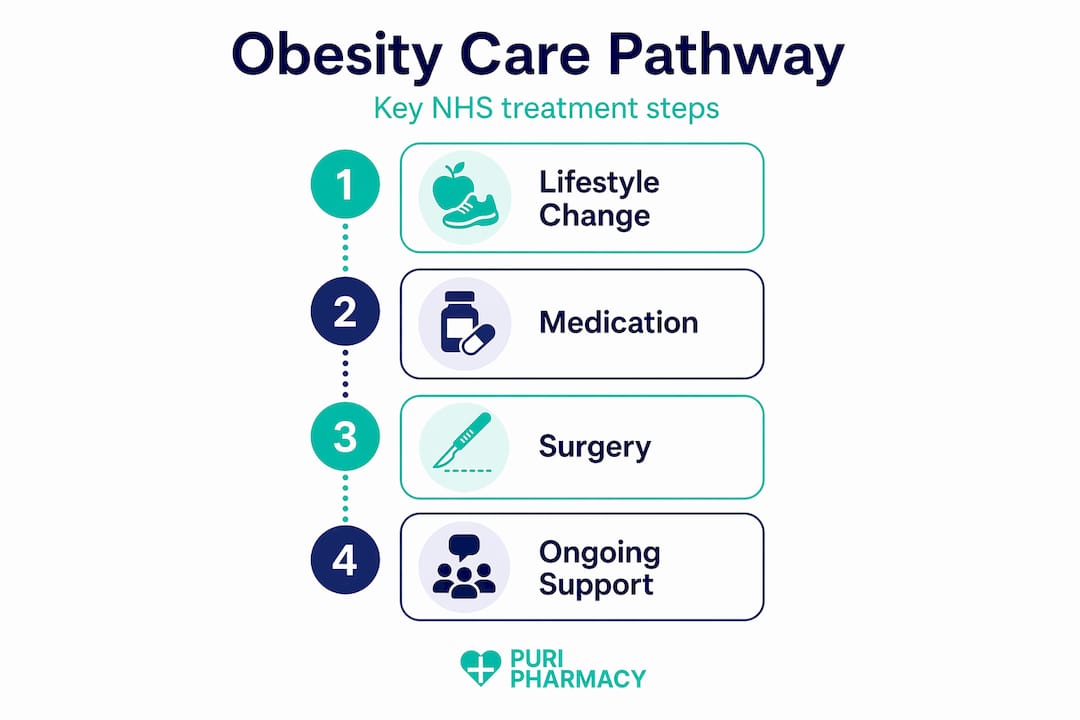
- Lifestyle changes, medicines and surgery: Treatment options
- A practical perspective: What most guides miss about clinical obesity
- How Puri Pharmacy supports your weight management journey
- Frequently asked questions
Key Takeaways
| Point | Details |
|---|---|
| Clinical vs. simple obesity | Clinical obesity means excess body fat is causing real health problems, not just high weight. |
| Diagnosis uses more than BMI | Doctors look at BMI, waist size, and health effects on your body—not just numbers. |
| Tiered NHS support | The NHS offers stepwise programmes, medicine, and surgery based on how severe your obesity is. |
| Lifestyle is first-line | Most people begin with diet and exercise support and only move to medicines or surgery if needed. |
| Local help is available | If you live in West London, you can access digital programmes and specialist help through the NHS or trusted pharmacies. |
How is clinical obesity defined?
Now that we’ve set out what clinical obesity actually means, let’s break down how it is defined and diagnosed.
Most of us are familiar with BMI, or Body Mass Index, which is calculated from your height and weight. A BMI of 30 or above is classified as obese, while a BMI of 25 to 29.9 falls into the overweight range. These thresholds have guided NHS care for decades, and they remain a practical starting point. However, they tell only part of the story.
The crucial distinction clinicians now make is between preclinical obesity and clinical obesity. In preclinical obesity, a person carries excess body fat but has not yet developed significant health complications directly linked to that fat. In clinical obesity, the excess fat causes organ dysfunction or meaningfully limits daily life. This might include type 2 diabetes driven by fat around the liver and pancreas, breathlessness from fat restricting the lungs, or joint damage that prevents someone from walking without pain. The health impact, not just the body size, is what places someone in the clinical category.
A newer, evidence-based framework has shifted focus further still. Rather than relying on BMI alone, this updated diagnostic approach incorporates additional body measurements and a direct assessment of whether organs are being affected or daily functioning is impaired. This shift has important practical consequences: someone with a BMI of 28 who has developed severe fatty liver disease and chronic joint pain may be classified as clinically obese, whereas someone with a BMI of 34 who is otherwise healthy and fully functional would not.
Why does this matter for you? Because a clinical diagnosis unlocks different levels of NHS support, including specialist referrals, weight management medicines, and potentially surgical options. Knowing where you stand helps you ask the right questions.
| Category | BMI range | Health impact present? | Qualifies as clinical obesity? |
|---|---|---|---|
| Healthy weight | 18.5 to 24.9 | No | No |
| Overweight | 25 to 29.9 | Possibly | Only if health impact confirmed |
| Preclinical obesity | 30 or above | No | No |
| Clinical obesity | Any range | Yes | Yes |
This table illustrates why the same BMI value can sit in very different clinical categories depending on whether health impacts exist. The person, not just the measurement, is what clinicians must assess.
BMI, waist size and functional health impacts: What really matters
Understanding the limits of BMI leads us to how obesity is really assessed in practice.

BMI has long been criticised for being a blunt instrument. It cannot distinguish between muscle and fat, nor does it say anything about where fat is stored in the body. A rugby player and a sedentary individual might share the same BMI but have very different health profiles. The location of fat matters enormously. Fat stored around the abdomen, known as visceral fat, is metabolically active and far more dangerous than fat stored beneath the skin in the thighs or arms.
This is why waist circumference has become an essential supplementary measure. For most adults in the UK, a waist measurement above 94 cm in men or 80 cm in women indicates a significantly raised risk of serious health conditions, including cardiovascular disease and type 2 diabetes. Above 102 cm in men and 88 cm in women, the risk is classified as very high.
Clinicians now use a more comprehensive assessment that pulls together BMI, waist circumference, body composition where possible, and a direct review of health consequences. Here is a summary of what a thorough clinical assessment typically examines:
- BMI measurement as an initial screening tool
- Waist circumference to identify central fat distribution
- Blood tests including HbA1c for diabetes risk, lipid profiles, and liver function markers
- Blood pressure readings taken on multiple occasions
- Assessment of symptoms such as breathlessness, fatigue, joint pain, or sleep disturbance
- Review of functional ability, including how well a person can manage stairs, daily tasks, and physical activity
Pro Tip: If you are attending a clinical assessment for weight management, keep a note of your symptoms over several weeks beforehand. Documenting when breathlessness, joint pain, or fatigue occurs and how often gives clinicians a much clearer picture than a single appointment can provide.
It is also worth understanding that clinical obesity is not fixed. A person can move between preclinical and clinical categories depending on how their health changes over time. Effective treatment can shift someone from clinical obesity back to a preclinical state even before significant weight loss occurs, because some interventions improve organ function directly. This is one reason why weight loss, while important, is not always the sole measure of success.
| Measure | What it assesses | Clinical obesity risk flag |
|---|---|---|
| BMI above 30 | Overall excess weight | Starting point only |
| Waist above 94 cm (men) | Central fat accumulation | Raised risk |
| Waist above 80 cm (women) | Central fat accumulation | Raised risk |
| HbA1c above 48 mmol/mol | Type 2 diabetes present | Direct health impact |
| Systolic BP above 140 mmHg | Hypertension present | Direct health impact |
Clinical obesity in West London: The NHS pathway explained
So, how does this understanding of clinical obesity translate into support or treatment, especially locally?
The NHS in West London has developed a structured, tiered system to support people with clinical obesity. This pathway is designed so that the level of support matches the severity and complexity of an individual’s needs. Here is how the tiers typically work:
-
Tier 1: Universal services. This includes general health promotion, public advice on nutrition and physical activity, and support available through your GP surgery or community pharmacy. It is appropriate for people who are overweight or at the early stages of preclinical obesity.
-
Tier 2: Structured lifestyle programmes. These are group or individual programmes offering guided nutrition advice, supported physical activity, and behavioural coaching. The North West London NHS pathway provides access to these programmes, which are typically delivered over 12 weeks and have a strong evidence base. Referrals are made through a GP.
-
Tier 3: Specialist multidisciplinary services. For people with clinical obesity and significant health complications, a specialist team including dietitians, physicians, clinical psychologists, and physiotherapists provides intensive, coordinated support. Weight management medicines may be introduced at this stage.
-
Tier 4: Bariatric surgery. This is considered for patients with severe clinical obesity, typically a BMI of 40 or above, or 35 and above with serious related conditions, when previous treatments have not achieved sufficient results. Surgery is not a first option but can be life-changing for the right patient.
Pro Tip: You do not have to wait until things feel serious to ask your GP for a referral. If your waist measurement, blood results, or day-to-day symptoms concern you, raise it directly. Early access to Tier 2 support is far easier to arrange than most people realise.
The NHS digital weight management programme is also available online for adults living with obesity alongside diabetes or hypertension, offering 12 weeks of structured guidance accessible via an app or website. This is a particularly useful option for people with busy schedules or who prefer working through a digital platform at their own pace.
Lifestyle changes, medicines and surgery: Treatment options
With the pathway in mind, let’s look more closely at the treatment and support available to you.
The foundation of any clinical obesity treatment is lifestyle change. This is not about following a restrictive fad diet or attending a gym seven days a week. Structured support from a trained dietitian or health coach, combined with a gradual increase in physical activity, consistently produces meaningful results. Even a 5% reduction in body weight can significantly improve blood pressure, blood sugar levels, and joint loading. Small, sustained changes outperform dramatic short-term efforts every time.
When lifestyle changes alone are not producing sufficient results or when a person’s health is deteriorating despite effort, weight management medicines become an important tool. The NHS now prescribes several options for eligible patients:
- Orlistat, which reduces the amount of fat absorbed from food
- Semaglutide (Wegovy), a weekly injection that works by mimicking a gut hormone to reduce appetite and slow digestion
- Tirzepatide (Mounjaro), a newer dual-action injection that targets two gut hormones for greater weight reduction than earlier medicines
These medicines are not offered without proper assessment. Criteria include BMI thresholds, presence of related health conditions, and evidence that lifestyle interventions have been tried. The latest weight management news from NHS clinical guidance shows that both semaglutide and tirzepatide are becoming more widely available through specialist NHS pathways, though private prescribing remains an option for those who wish to access treatment more quickly.
Bariatric surgery, when appropriate, produces the most significant and sustained weight loss of any available treatment. Procedures such as gastric sleeve or gastric bypass surgery can result in 20 to 35% total body weight loss, and in many cases cause remission of type 2 diabetes. However, surgery involves considerable preparation, lifelong dietary changes, and ongoing monitoring. It is offered only when strict clinical criteria are met and should be seen as part of a long-term health plan, not a standalone solution.
What should you ask your care provider? A few key questions are worth raising: What tier of support am I eligible for? Has my waist circumference been measured alongside my BMI? Are there any medicines I should consider? What are the next steps if my current approach is not working?
A practical perspective: What most guides miss about clinical obesity
From our experience working with people in West London who are navigating weight management, the biggest obstacle is rarely a lack of information. It is the persistent belief that a number on the scale is the only measure of progress that matters.
Clinical obesity frameworks push back against this in a compelling way. They ask not “how heavy are you?” but “what is your health doing right now, and is your weight contributing to that?” This is a genuinely different question, and it leads to genuinely different conversations between patients and clinicians.
The pitfall we see most often is people setting a BMI target as their goal and feeling like failures when they cannot reach it quickly enough. Meanwhile, their blood pressure has normalised, their sleep apnoea has improved, and they are walking further than they have in years. These are meaningful clinical improvements. They deserve to be celebrated and tracked.
Wegovy, for example, has generated enormous interest partly because it delivers visible weight loss. But the more important story in the clinical trials was the reduction in cardiovascular events and the improvements in metabolic health markers. Weight loss is a proxy for the outcomes that actually matter.
Our frank view is that functional health, meaning how well your body works in daily life, should be the primary target. When you organise your goals around energy, mobility, and reducing disease risk rather than simply a number on a scale, your motivation becomes more durable and your progress more meaningful.
How Puri Pharmacy supports your weight management journey
If you have been reading this and recognising elements of your own situation, taking the next step does not need to feel overwhelming.

At Puri Pharmacy in West London, we offer accessible, trusted support for people at every stage of their weight management journey. Whether you are exploring your options for the first time or are ready to start a prescribed medicine, our team is here to help. You can find out more about Wegovy injections through our private prescribing clinic, access the NHS digital weight management programme, or visit our dedicated weight loss clinic in Southall for a full consultation. Our pharmacists understand local needs and can guide you towards the right pathway, whether NHS or private.
Frequently asked questions
Is clinical obesity the same as having a high BMI?
No. Clinical obesity only applies when excess body fat is causing direct health impairment or organ dysfunction, regardless of what the BMI reading shows.
What is the main difference between preclinical and clinical obesity?
Preclinical obesity means excess fat is present without health problems yet, while clinical obesity means excess fat is actively causing organ dysfunction or major limitations in daily life.
What medicines are used for clinical obesity on the NHS?
The NHS prescribes medicines including tirzepatide and semaglutide for weight management when lifestyle changes have not been sufficient, as outlined in current NHS guidance.
When is bariatric surgery considered for clinical obesity?
Surgery is considered when severe clinical obesity meets strict NHS criteria, including a BMI above 40 or above 35 with serious related conditions, and only after other treatments have not produced sufficient results.
Can you reverse clinical obesity with lifestyle changes?
Many people do improve their health substantially and can move out of the clinical obesity category through structured lifestyle programmes, particularly when supported by a dietitian or specialist health team.