How to create a weight loss journal that works

TL;DR:
- Creating a weight loss journal transforms vague intentions into clear patterns, aiding self-awareness and progress tracking. Using simple tools and setting realistic goals, individuals can monitor habits, emotions, and triggers effectively. Consistency and a supportive mindset turn journaling into a positive partnership for lasting weight management.
Starting a weight loss journey without the right tools is like navigating London without a map. You move, but you’re not sure where you’re going. Knowing how to create a weight loss journal gives you that map. It turns vague intentions into visible patterns, helping you understand not just what you eat, but why you eat it, when your energy dips, and what actually moves the needle. This guide walks you through every step, from picking up a pen or opening an app, to reviewing your entries like a seasoned habit detective.
Table of Contents
- How to create a weight loss journal: gather your tools and set realistic goals
- Start your journal by tracking your current habits
- Structure your journal to capture context and emotions
- Maintain consistency and review your progress regularly
- Choose the right journal format for your lifestyle
- Rethinking the weight loss journal: from punishment to progress partner
- Support your weight loss journey with professional services in West London
- Frequently asked questions
Key Takeaways
| Point | Details |
|---|---|
| Start simply | Track your current eating, activity, and sleep habits for a few days to establish a clear baseline. |
| Add context | Include where, who, and how you feel during meals to identify triggers and patterns. |
| Consistency matters | Aim to journal at least 75% of your planned eating and activity to increase weight loss success. |
| Review regularly | Set review times to adjust goals and plans instead of reacting to daily fluctuations. |
| Choose practical tools | Use paper or digital formats that fit your lifestyle and encourage consistent journaling. |
How to create a weight loss journal: gather your tools and set realistic goals
Before you write a single entry, you need two things: something to write in and something worth writing down. The good news is that neither needs to be complicated.
Your basic toolkit:
- A dedicated notebook (A5 works well for portability around West London) or a journalling app on your phone
- A pen you actually enjoy using, or a phone you already carry everywhere
- Five minutes at a consistent time of day, morning or evening
The second essential is your goals. Set short-term, specific, realistic goals before you begin journalling, because goals without structure lead to journalling without purpose. “Lose weight” is not a goal you can track. “Walk 8,000 steps four days a week for the next three weeks” is.
Write your reasons for starting on the very first page. Not your target weight. Your why. The school run, the stairs at work, feeling good in your clothes again. These entries become your most valuable resource when motivation drops, and it will drop.
Here is a simple overview of journalling tools and what suits each type of person:
| Tool | Best for | Main advantage |
|---|---|---|
| Paper notebook | People who switch off from screens at home | Tangible, no battery needed |
| Notes app (iPhone/Android) | Logging on the go instantly | Always in your pocket |
| Dedicated tracking app | Those who want data summaries | Auto-calculates and reminds you |
| Printed planner | Visual planners and list-makers | Structure is built in |
If you are already enrolled in or considering the NHS digital weight management programme, pairing that structure with your personal journal doubles the accountability.
Pro Tip: Do not spend a week finding the “perfect” journal. Start with whatever you have today. A journal you use beats one you are still waiting to begin.
Start your journal by tracking your current habits
With your goals set and tools ready, begin by capturing a clear picture of your current habits through detailed tracking.
Most people underestimate how much they eat and overestimate how much they move. A few honest days of baseline tracking will surprise you, and that surprise is the point.
-
Record every meal and snack. Note the type of food, the amount, and the time. Track foods and beverages as soon as you consume them, and be specific about portions and condiments. That splash of olive oil counts. So does the biscuit you had with your tea.
-
Log your physical activity. Write the type of movement (walking, gym, cycling), the time of day, and how long it lasted. Even a fifteen-minute walk from the Tube to your office is worth noting.
-
Include your sleep hours. Track sleep alongside eating and activity because poor sleep directly affects hunger hormones and food choices the next day.
-
Note your water intake. Dehydration is routinely mistaken for hunger, particularly during the working day in a busy city environment.
-
Do this for at least three to five days before analysing anything. You need a genuine sample, not a single “good day” you are performing for the journal.
Connecting your daily patterns to wider health data can be useful too. Resources around longevity and lifestyle habits can help you understand why sleep and hydration appear in weight management advice so consistently. For ongoing reading on this topic, the Puri Pharmacy health and wellness news section regularly covers practical insights.
Pro Tip: Log your meals on your phone before you leave the table, not hours later. Memory is a generous editor when it comes to what we ate.
Structure your journal to capture context and emotions
After logging basics, enriching your journal with context and emotions deepens self-awareness and improves planning.

Here is where most weight loss diaries stay shallow. They record what was eaten but never why. Adding just a few contextual details transforms your journal from a food ledger into a genuine behaviour map.
For each meal or snack, consider adding:
- Location: Were you at your desk, in the car, on the sofa watching television?
- Company: Were you eating alone, with colleagues, with family?
- Mood: Stressed, bored, genuinely hungry, happy, rushing?
- Hunger level: Rate it from 1 (barely hungry) to 5 (ravenous) before and after eating
Capturing where you are, who you are with, and your feelings during eating adds valuable insight for managing triggers. You might discover that you consistently overeat when you work late, or that social lunches derail your intentions more than evening meals do.
The journal is not a confessional. It is a data collection tool. There is no “bad” entry, only honest ones and missing ones. Write what happened without commentary or self-criticism.
Once you spot a pattern, you can plan around it. If you notice you graze through the kitchen at 4pm every day, that is useful information. It tells you to prepare a satisfying snack in advance rather than relying on willpower in the moment. Understanding triggers is where the NHS digital weight management programme also focuses a great deal of its structured support.
Maintain consistency and review your progress regularly
Consistency in journalling builds habits; the next step is to review your data regularly for meaningful progress.
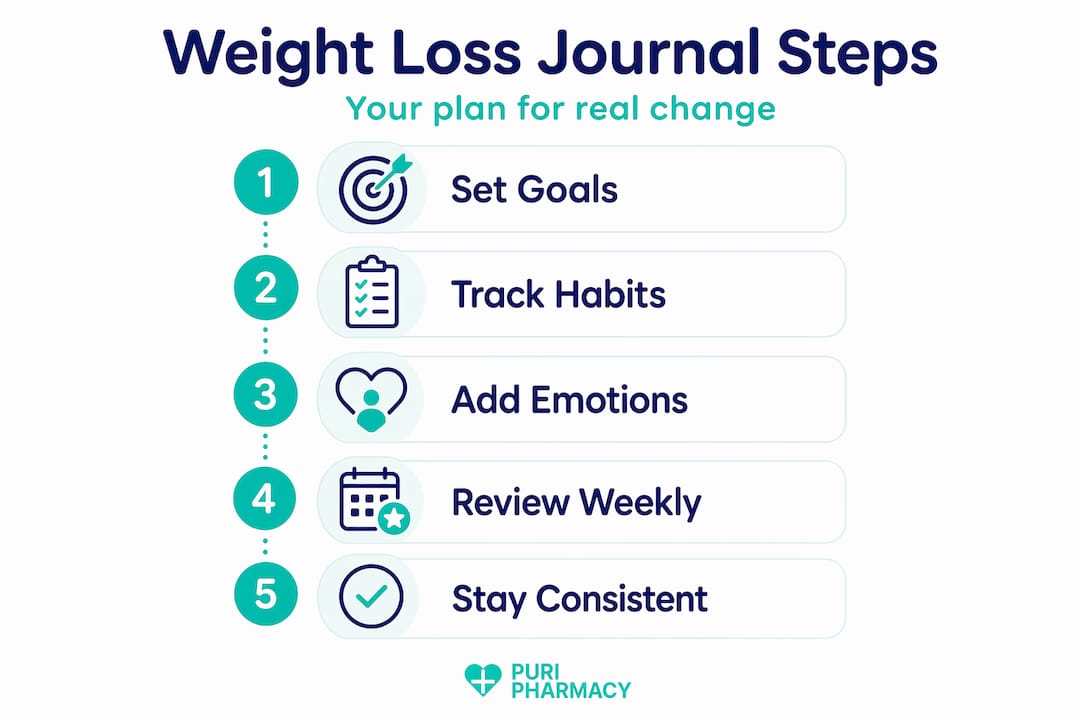
Logging at least 75% of planned activities is strongly linked to effective weight loss. In practical terms, that means aiming for five to six days of entries per week. Perfect every day is unnecessary and unsustainable. Five-out-of-seven is genuinely excellent.
How to build your review rhythm:
- End of each day: Spend two minutes completing any missed entries. Do not reconstruct the whole day; capture the highlights.
- End of each week: Read back through your entries. What patterns appear? Where did you do well? Where did you struggle?
- End of each month: Review your journal periodically to revisit your goals and adjust your plan. Did you hit your short-term targets? What needs to change for next month?
Here is a simple review framework to guide your weekly and monthly check-ins:
| Review type | Frequency | Focus area |
|---|---|---|
| Quick scan | Daily (2 minutes) | Complete missing entries |
| Pattern review | Weekly (15 minutes) | Spot habit trends, note wins |
| Goal reset | Monthly (30 minutes) | Update targets, celebrate progress |
The weekly review is especially important for staying grounded. Your weight will fluctuate day to day due to hydration, hormones, and salt intake. A single number on a Tuesday morning tells you almost nothing. A month of journal entries tells you everything.
Pro Tip: Weigh yourself on the same day each week, at the same time, wearing the same thing. Plot that number in your journal rather than reacting to it in isolation.
Choose the right journal format for your lifestyle
With an understanding of journalling consistency, selecting a format that fits your lifestyle supports ongoing success.
There is no universally superior format. The right one is the one you will actually use on a wet Wednesday evening after a long commute.
| Feature | Paper journal | Digital app |
|---|---|---|
| Setup time | Instant | A few minutes |
| Reminders | None | Automated push notifications |
| Data summaries | Manual | Automatic charts and trends |
| Privacy | High (physical) | Depends on app settings |
| Flexibility | Total | Limited to app structure |
| Cost | Low (notebook only) | Free to premium subscription |
Digital self-monitoring tools, when used consistently, show strong links to weight loss success across diet, activity, and weight tracking. But the key word is “consistently.” A paper journal used every day outperforms an app opened twice a week.
What to look for in a journalling app:
- Barcode scanning for fast food logging
- A mood or emotion check-in feature
- Weekly summary emails or reports
- Ability to add free-text notes, not just numbers
Starting immediately with any available format, paper or digital, is key. Delay is the enemy of habit formation. If you are interested in how tracking fits into a broader approach to long-term health, exploring longevity-focused health strategies can offer additional framing for why consistent self-monitoring matters far beyond weight management.
Rethinking the weight loss journal: from punishment to progress partner
Here is the perspective that most weight loss advice avoids: the journal fails most people not because of what they log, but because of how they feel about logging it.
The moment an entry gets missed, guilt creeps in. That guilt becomes avoidance. Avoidance becomes abandonment. The journal, rather than feeling like a tool, starts to feel like evidence of failure.
This is backwards. The journal is meant to help spot patterns and make small changes, not to punish or shame you for being human. A missed entry is not a broken promise. It is a gap in data. Nothing more.
The most effective journallers we see are not the ones who log every single calorie with obsessive precision. They are the ones who miss a day, shrug, and pick it back up the next morning. Consistency over time always beats intensity over a short burst.
There is also a deeper reframe worth considering. Most people use their journal to measure whether they are “being good.” Flip that entirely. Use it to understand yourself. The entries that feel most uncomfortable, the late-night snacking, the skipped workouts, the emotional eating, are your most valuable entries. Not your worst ones. Your most informative ones.
If you are based in West London and using an NHS digital weight management programme alongside your journal, that combination of professional structure and personal self-awareness is genuinely powerful. But neither works if the journal becomes a source of shame rather than insight.
Progress is not linear. Your journal should reflect that reality honestly, not perform a sanitised version of your journey for an invisible audience.
Support your weight loss journey with professional services in West London
A well-kept journal is one of the most effective tools available, but it works best alongside the right professional support.

At Puri Pharmacy, we work with people across West London who are serious about their weight loss goals and want more than generic advice. Our NHS digital weight management programme pairs structured digital support with the guidance of experienced pharmacy professionals. For those who need additional clinical intervention, our private prescribing weight loss service includes access to treatments such as Wegovy, with full medication management and ongoing support. Whether you are just starting out or have been struggling to maintain momentum, we are here to help you turn your journal insights into lasting results.
Frequently asked questions
How often should I write in my weight loss journal?
Aim to log your eating and activity at least five to six days per week. Recording at least 75% of behaviours is consistently linked to greater weight loss outcomes.
What should I include besides food and exercise in my journal?
Include sleep hours, mood, and eating context such as where you were and who you were with. Journalling with context and emotions helps identify triggers so you can build practical coping strategies.
Is it better to use a paper journal or a digital app?
Choose whichever format you are most likely to use every day. Consistent use of digital tools supports strong outcomes, but the format matters far less than the habit of using it.
How do I keep journalling from becoming overwhelming?
Start with three to five days of simple tracking, keep entries brief, and review weekly rather than obsessing over each day. Focusing on overall consistency rather than daily perfection keeps the process sustainable.
Can a weight loss journal help with emotional eating?
Yes. By recording your feelings and the context around each eating episode, you begin to see patterns clearly. Capturing thoughts and feelings alongside food intake is a recognised approach for managing emotional and binge eating triggers.