The role of earwax in health: what you need to know

TL;DR:
- Earwax is a protective, antimicrobial secretion that supports ear health and prevents infections, contrary to common beliefs. Over-cleaning with cotton buds damages the ear’s natural self-cleaning process and can cause impaction, which is more prevalent than many realize. Professional removal methods like microsuction are safe options when impaction occurs, allowing the ear’s natural defenses to function effectively.
Earwax has an image problem. Most people reach for a cotton bud at the first sign of it, convinced it is something to be removed as quickly as possible. But the role of earwax in health is far more significant than most people realise. It is not a sign of poor hygiene. It is an actively produced secretion your body makes on purpose, designed to protect one of your most important sensory systems. Understanding what earwax actually does changes how you care for your ears entirely.
Table of Contents
- Key takeaways
- What earwax is actually made of
- How earwax protects your hearing
- When earwax becomes a problem
- Safe earwax care and common myths
- Earwax and your ear canal microbiome
- My take: we have been cleaning our ears wrong for decades
- Professional earwax care at Puripharmacy
- FAQ
Key takeaways
| Point | Details |
|---|---|
| Earwax is protective, not dirty | It is a complex secretion with antimicrobial and moisturising properties your body produces deliberately. |
| Over-cleaning causes real harm | Using cotton buds pushes wax deeper and disrupts the natural self-cleaning mechanism. |
| Impaction is more common than you think | Around 10% of children and 5% of adults experience earwax build-up that needs professional attention. |
| Most ears clean themselves | Jaw movement and skin migration naturally move wax out of the canal without any help from you. |
| Professional removal is the safest option | Microsuction is the gold standard when earwax does become a clinical problem. |
What earwax is actually made of
Most people picture earwax as a single, uniform substance. In reality, it is a surprisingly complex biological secretion produced by two types of glands in the outer ear canal: sebaceous glands and apocrine glands. The result is a mixture of shed skin cells, secreted lipids, and specialised proteins that work together to maintain ear health.
Earwax is approximately 60% keratin by dry weight, with the remainder comprising fatty acids, cholesterol, and antimicrobial proteins. That composition is not accidental. Each component serves a purpose:
- Keratin forms a physical scaffold that traps debris and particles before they can travel deeper into the canal.
- Fatty acids and cholesterol provide the lipid layer that lubricates the skin lining the ear canal, preventing dryness and microscopic tears.
- Antimicrobial peptides including human beta defensins and lactoferrin target bacteria and fungi with broad-spectrum activity.
- Immunoglobulins contribute an additional layer of immune-mediated defence at the canal surface.
One of the most underappreciated features of earwax is its pH. Earwax maintains an acidic pH around 6.1, which directly inhibits the growth of bacteria and fungi. Many common ear pathogens cannot survive in an acidic environment, meaning your earwax is creating a hostile atmosphere for infection before your immune system even needs to respond.
Pro Tip: If you swim regularly, chlorine and water exposure can dilute and remove earwax faster than it is replaced. This is one of the most common reasons swimmers develop outer ear infections, sometimes called “swimmer’s ear.” A light application of mineral oil before swimming can help maintain this protective barrier.
Earwax colour and texture vary between individuals and change with age. Wet, honey-coloured wax is typical in adults of European and African descent. Drier, flakier, grey wax is more common in people of East Asian ancestry. Neither type is more or less protective. The underlying function of earwax remains consistent regardless of appearance.
How earwax protects your hearing
The function of earwax goes well beyond simply existing in the ear canal. It is an active, multi-layered defence system. Here is how each mechanism works in practice:
-
Physical barrier formation. Earwax acts as a barrier stopping dust, debris, insects, and bacteria from reaching the eardrum. Without it, the delicate skin of the inner ear canal and the eardrum membrane would be directly exposed to everything in the environment.
-
Moisture regulation. Lipids in earwax maintain the integrity of the ear canal skin. A dry ear canal is a cracked ear canal, and cracked skin is an open invitation to infection. The waxy coating keeps the canal supple and intact.
-
Antimicrobial defence. The combination of acidic pH, antimicrobial peptides, and immunoglobulins means earwax actively kills or suppresses pathogens rather than just blocking them mechanically. Antimicrobial peptides like beta defensins show broad-spectrum activity against bacteria and fungi, and crucially, fewer pathogens have developed resistance to them compared to conventional antibiotics.
-
Self-cleaning migration. The ear canal has a remarkable self-cleaning mechanism. Earwax migrates outward through a combination of epithelial cell migration and the mechanical action of jaw movement when you chew or talk. Old wax, along with anything trapped in it, moves steadily towards the outer ear where it dries and flakes away naturally.
“The ear has one of the most sophisticated self-cleaning mechanisms in the human body. The skin of the ear canal grows outward from the eardrum like a conveyor belt, taking debris with it. Interfering with this process is one of the most common causes of ear problems we see.” — Clinical observation from ear health practitioners
Understanding how earwax protects hearing requires appreciating that this process is continuous and largely invisible. Most people never need to do anything to facilitate it. The problems begin when people decide to help.
When earwax becomes a problem
Earwax becomes a clinical issue when the natural migration process fails to keep pace with production, or when external interference disrupts it. The result is cerumen impaction, and it is more prevalent than most people assume.
| Affected group | Approximate impaction rate | Common contributing factors |
|---|---|---|
| Children | ~10% | Narrow ear canals, frequent ear infections |
| Healthy adults | ~5% | Cotton bud use, hearing aid wear |
| Elderly adults | Higher than general population | Drier, harder wax, reduced jaw movement |
| Hearing aid users | Significantly elevated | Device blocks natural migration |
Cerumen impaction affects about 10% of children and 5% of adults, with rates rising considerably in older populations. Hearing aids and in-ear headphones are significant contributors in adults because they physically obstruct the outward migration path.
Symptoms of impaction worth recognising include muffled hearing, a sensation of fullness in the ear, tinnitus, and itching. One symptom that surprises people is earwax impaction triggering a chronic cough through Arnold’s reflex, a nerve reflex arc where the vagus nerve, which supplies part of the ear canal, triggers coughing when stimulated. If you have an unexplained persistent cough with no respiratory cause, blocked earwax is worth considering.
Pro Tip: Never attempt to remove earwax with a cotton bud if you are experiencing any pain, discharge, or suspected eardrum perforation. These are signals that something more serious may be happening, and professional assessment at a pharmacy or GP surgery is the right step.
Cotton buds compact wax deeper into the canal, disrupting the natural outward migration and often creating the very impaction they are meant to prevent. The outer ear, the bit visible in the mirror, is the only part that ever needs gentle cleaning with a cloth. The canal manages itself.
Safe earwax care and common myths
Understanding what not to do with earwax is just as important as understanding what it does. A few persistent myths continue to cause real harm.
The cotton bud myth. Cotton buds are designed for cosmetics, not ears. Every major ear health body advises against their use inside the canal. They push wax inward, abrade the delicate skin lining, and remove the very secretion that keeps the canal protected. The instruction printed on many cotton bud packets to not insert them into the ear canal exists for exactly this reason.
The ear candle myth. Ear candles have no clinical evidence supporting their use and carry genuine risks including burns, blockages caused by candle wax entering the canal, and eardrum perforation. They do not create sufficient negative pressure to extract earwax, and the debris found in the remnant of a burned candle is the candle material itself, not earwax.
The “clean ears are healthy ears” myth. Earwax is healthy and should largely be left alone. The absence of earwax creates a dry, unprotected canal far more susceptible to infection and irritation than one with a normal coating of wax.
For people who do experience build-up, safe at-home options include:
- Softening drops such as olive oil or mineral oil, applied for several days before the wax works its way out naturally.
- Diluted hydrogen peroxide solutions available from pharmacies, used carefully according to instructions.
- Warm water irrigation kits, used gently and only when there is no history of eardrum perforation or ear surgery.
When these approaches do not work, or when symptoms are significant, professional removal is the correct step.
Earwax and your ear canal microbiome
The study of earwax has expanded beyond its obvious mechanical functions. Researchers are increasingly interested in how earwax interacts with the microbial community living in the ear canal, and what this means for infection prevention.
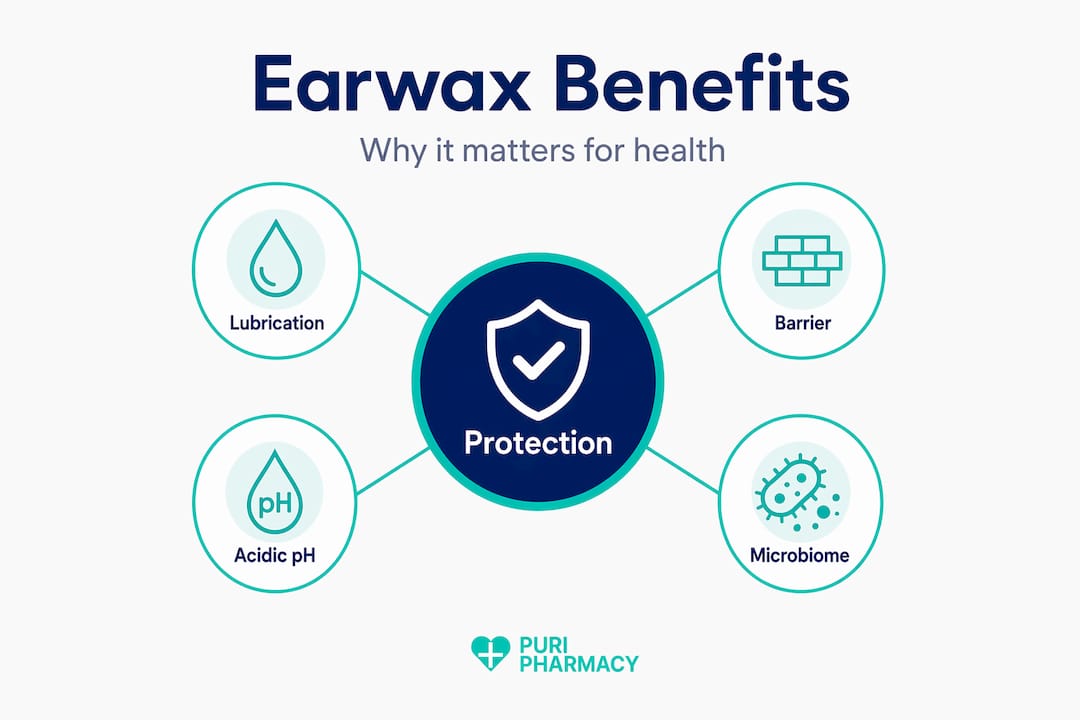
The ear canal is home to a resident microbiome, a stable community of bacteria that occupy the canal surface and, through colonisation resistance, prevent pathogenic organisms from taking hold. Earwax supports this system directly. Its antimicrobial properties are selective enough to suppress true pathogens while permitting the survival of commensal bacteria that form this protective community. Strip away earwax through excessive cleaning, and you disrupt both the physical barrier and the microbial balance simultaneously.
Antimicrobial peptides in earwax including lactoferrin have been shown to have broad-spectrum activity against bacteria and fungi while exhibiting lower resistance rates than conventional antimicrobials. This selectivity is what makes them so valuable. Researchers are now exploring whether the antimicrobial components of earwax could inform the development of new treatments for outer ear infections, particularly as antibiotic-resistant otitis externa becomes a growing clinical concern.
“The more we understand about the ear canal’s natural defences, the clearer it becomes that earwax is not a problem to be solved. It is part of the solution.” — Emerging consensus in ear canal microbiome research
The relationship between altered earwax composition and increased ear infection risk is well documented. People with conditions affecting lipid secretion, or those who have had repeated courses of antibiotics, often show disrupted wax composition alongside elevated rates of outer ear infections. This points to earwax not just as a barrier, but as an active participant in maintaining a stable, infection-resistant ear environment.
My take: we have been cleaning our ears wrong for decades
In my experience, the single most common cause of ear problems I see is not disease, not genetics, not exposure to water. It is people trying to keep their ears clean. The habit of reaching for a cotton bud after every shower is deeply ingrained, and it causes a remarkable amount of preventable harm.
I have seen patients with recurrent outer ear infections who were faithfully cleaning their ears daily. Once they stopped, the infections stopped. The ear canal, left to its own devices, is extraordinarily good at managing itself. The patients who have the worst earwax problems are almost always the ones who have been most diligent about removing it.
What I find equally telling is that patients often come in anxious about earwax they can see. They assume visible wax means something is wrong. It does not. Visible wax at the outer canal opening is the system working exactly as it should. The wax has migrated outward and is ready to be gently wiped away with a cloth. That is all.
The red flags I always tell people to act on are hearing loss that comes on quickly, pain, discharge, or a feeling of pressure that does not resolve. Those warrant professional attention. For everyone else, my honest advice is to leave your ears alone and let them do what they have been doing for hundreds of thousands of years.
— R
Professional earwax care at Puripharmacy
If you are experiencing muffled hearing, a sense of fullness, or persistent itching in your ears, it is worth getting your ear canals properly assessed rather than attempting home removal. At Puripharmacy, the team offers professional earwax removal in Southall and Hillingdon using safe, clinically appropriate methods.

Microsuction avoids the moisture and pressure associated with traditional syringing, reducing the risk of vertigo and outer ear infection. It is the method recommended by ear health specialists and is particularly well suited to patients with narrow canals, a history of ear surgery, or those who have not responded to softening drops. Puripharmacy also serves patients across west London, with earwax removal in Heathrow and earwax removal near Beaconsfield available for those further afield. If you are unsure whether you need treatment, a quick consultation will give you a clear answer.
FAQ
Do I need earwax to stay healthy?
Yes. Earwax lubricates the ear canal, traps debris and bacteria, and maintains an acidic environment that resists infection. Removing it entirely leaves the canal dry and vulnerable.
What happens if I clean my ears too often?
Frequent cleaning, especially with cotton buds, disrupts the ear’s natural self-cleaning process, pushes wax deeper, and removes the protective coating that guards against infection and dryness.
How do I know if my earwax is causing a problem?
Key signs of earwax impaction include muffled or reduced hearing, a sensation of fullness, tinnitus, itching, or an unexplained cough. If any of these persist, professional assessment is advisable.
Is microsuction safe for earwax removal?
Microsuction is widely regarded as the safest method for professional earwax removal. It uses gentle suction without water or pressure, making it suitable for most patients including those with sensitive or surgically altered ears.
Can earwax prevent ear infections?
Yes. The combination of acidic pH, antimicrobial peptides, and lipids in earwax actively inhibits bacterial and fungal growth, providing a frontline defence against outer ear infections.