How to stay motivated losing weight: real strategies

TL;DR:
- Motivation fluctuates and relies more on systems and identity than willpower when losing weight.
- Building habits aligned with a healthy identity and setting SMART goals sustain progress despite setbacks.
Knowing how to stay motivated losing weight is one of the most searched questions in the health and fitness space, and for good reason. Most people do not struggle to start. They struggle to continue. You eat well for two weeks, the scales barely move, and suddenly the energy that felt so strong at the start begins to fade. This guide goes beyond the usual “believe in yourself” advice to give you tested, psychologically informed strategies that work even when willpower does not. Whether you are just starting out or trying to restart after a setback, what follows will help.
Table of Contents
- Key takeaways
- How to stay motivated losing weight: the psychology behind it
- Setting goals that actually support your motivation
- Practical ways to boost weight loss motivation daily
- Managing plateaus and keeping motivation alive long-term
- My honest take on staying motivated
- Support for your weight loss journey at Puripharmacy
- FAQ
Key takeaways
| Point | Details |
|---|---|
| Motivation naturally fluctuates | Accepting this stops you quitting when drive dips; systems matter more than feelings. |
| Identity shapes behaviour | Seeing yourself as a healthy person creates automatic habits that do not rely on daily motivation. |
| SMART goals reduce overwhelm | Realistic targets of 1 to 2 lbs per week keep expectations grounded and motivation intact. |
| Self-compassion outperforms self-criticism | Treating setbacks as data rather than failures sustains long-term progress and adherence. |
| Plateaus are physiological, not personal | Strategic diet breaks and small adjustments counter metabolic adaptation without derailing progress. |
How to stay motivated losing weight: the psychology behind it
Most people treat motivation as a switch. Either you have it or you do not. That framing is the first thing to let go of. Motivation is a fluctuating state, not a permanent condition, and treating it as the latter sets you up for disappointment every time it dips.
One of the most persistent myths in weight loss is that successful people stay motivated all the time. They do not. What separates those who reach their goals from those who do not is what they do on the days when motivation is low. Identity-based habit formation reduces reliance on motivation fluctuations by shifting the internal narrative. When you define yourself as someone who is active or someone who eats well, your behaviour starts to follow that identity even on hard days. That is a fundamentally different engine from willpower.
Psychological barriers are worth taking seriously here. Emotional eating often arises from unresolved feelings, and when distress drives food choices, motivation strategies alone will not be enough. Recognising this pattern is not a weakness. It is useful information. Therapy, journalling, or even simply pausing before eating to ask yourself what you are actually feeling can interrupt the cycle.
“You do not rise to the level of your goals. You fall to the level of your systems.” This applies directly to weight loss. When your system is solid, a bad day does not become a bad month.
Self-compassion is not soft. Research shows that positive self-talk sustains perseverance through setbacks far better than self-criticism. The inner critic voice that says “you’ve ruined everything” is not motivating you. It is exhausting you.
Pro Tip: When motivation dips, do not ask yourself how to get it back. Ask yourself what the smallest possible healthy action is right now. One glass of water. A ten-minute walk. These micro-actions rebuild momentum without requiring emotional energy you do not have.
Setting goals that actually support your motivation
There is a specific reason why so many people feel motivated at the start and deflated by week four. Their goals were set with optimism, not evidence. Health experts recommend a sustainable weight loss rate of 1 to 2 pounds per week, and when expectations exceed that, the perceived lack of progress feels like failure even when progress is happening.
SMART goals enhance motivation and achievement precisely because they give you something measurable to anchor to. Here is how to apply this to staying motivated for weight loss:
- Specific: Define exactly what you want. Not “lose weight” but “lose 10 lbs before my holiday in August.”
- Measurable: Track the metric weekly. Use a journal, app, or simple spreadsheet.
- Achievable: Base targets on the 1 to 2 lbs per week recommendation, not on what you want to be true.
- Relevant: Connect the goal to something that genuinely matters to you. Better energy for your children, fitting into clothing you love, or improving a health marker.
- Time-based: Set a realistic end date, then break it into monthly and weekly targets.
Beyond goal structure, your environment matters enormously. Preparing meals on Sundays, keeping easy healthy snacks visible, and reducing friction around exercise all reduce the daily decisions that drain motivation. Habits built into your routine do not ask for motivation. They just happen.
| Strategy | Why it works |
|---|---|
| Weekly weigh-ins at the same time | Removes daily fluctuations and gives accurate trend data |
| Meal prepping on Sundays | Removes decision fatigue and reduces impulse eating mid-week |
| Sleep: 7 to 9 hours per night | Adequate sleep regulates appetite and reduces stress-induced eating |
| Food and mood journalling | Builds awareness of emotional eating triggers over time |
Pro Tip: Connect your weight loss goal to a core personal value, not just an aesthetic. “I want to feel strong enough to hike with my family” lasts longer as a motivator than “I want to fit into smaller jeans.”
Practical ways to boost weight loss motivation daily
Motivation techniques for weight loss work best when they are woven into ordinary life rather than treated as special events. The following are evidence-informed, practical, and designed for real people with real schedules.
- Break targets into weekly wins. Instead of fixating on a total number, celebrate losing the first pound, completing three workouts in a week, or cooking at home five nights in a row. Small wins sustain perseverance and build genuine confidence.
- Find movement you actually enjoy. The most effective exercise for weight loss is the one you will do consistently. Dance classes, swimming, walking with a podcast, or a football game with friends all count. Enjoyment is a motivational strategy.
- Use an accountability partner. Telling someone else your goals changes the psychological contract. You are no longer accountable only to yourself, which matters on low-motivation days. Social support is one of the most underrated weight loss motivation tips available.
- Mute social media accounts that make you feel inadequate. Comparing yourself to edited social media images lowers confidence and motivation. This is not a minor point. Curate your feed deliberately.
- Try watching food videos to reduce cravings. It sounds counterintuitive, but visual food exposure creates partial satiation, reducing the desire to actually consume the food. It is a small behavioural tweak that doctors genuinely recommend.
- Eat your larger meals earlier in the day. Aligning food intake with your body’s natural rhythms can improve satiety and reduce evening overeating, which is often where motivation breaks down.
Pro Tip: Schedule your workouts like appointments in your calendar. When exercise is treated as a confirmed commitment rather than something you will do “if you feel like it,” attendance goes up significantly.
Managing plateaus and keeping motivation alive long-term

A plateau is not a sign that something has gone wrong. It is a sign that your body has adapted. This is one of the most important reframes in effective weight loss motivation strategies.
| Unhelpful response to a plateau | Helpful response to a plateau |
|---|---|
| Cutting calories dramatically | Implementing a 7 to 14 day diet break at maintenance calories |
| Giving up and restarting | Reviewing habits and identifying one small change to make |
| Blaming yourself for lack of willpower | Recognising metabolic adaptation as a physiological process |
| Trying a crash diet or cleanse | Adjusting exercise volume or adding a new activity modality |
Diet breaks of 7 to 14 days at maintenance calories are a legitimate, research-supported strategy. They counter metabolic fatigue, reset hunger hormones, and often reignite motivation by giving you a mental rest from deficit eating. This is not quitting. It is periodisation, and it works.
The deeper challenge with plateaus is the psychological one. A 35% regain rate within five years exists partly because people abandon their approach the moment progress stalls, rather than treating the plateau as data. When you use setbacks as data points to refine your strategy, you become a more sophisticated, more resilient person.
“The goal is not to be perfect for six weeks. The goal is to be consistent for six months. Imperfect consistency beats perfect short bursts every time.”
Pro Tip: If you have been in a calorie deficit for more than 12 weeks without a break, schedule a two-week maintenance period. Not a free-for-all. Just eating at maintenance. Your motivation and your metabolism will both benefit.
My honest take on staying motivated
I have worked with enough people at Puripharmacy to know that the ones who sustain weight loss long-term rarely describe themselves as “motivated.” They describe themselves as consistent. That distinction matters more than most advice acknowledges.
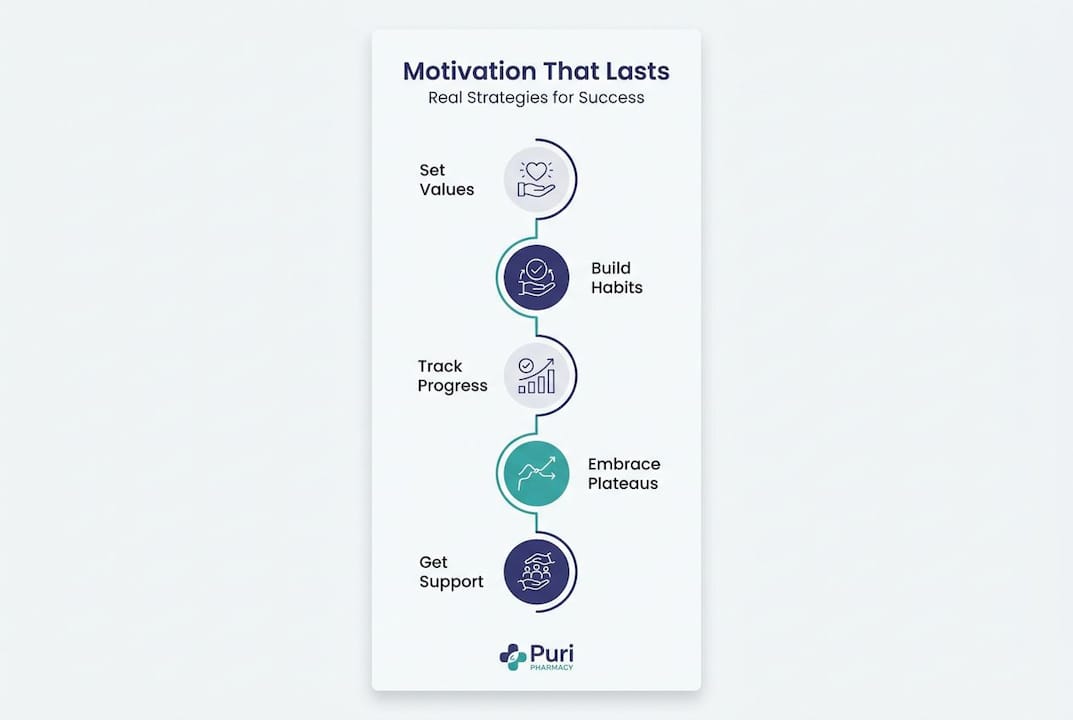
In my experience, the single biggest shift comes when someone stops framing weight loss as a test of their character and starts treating it as a practical project with variables to adjust. When the scales do not move, the question is not “what is wrong with me?” It is “what do I need to change this week?”
Self-compassion is not something I used to take seriously as a motivation strategy. Now I think it is the most underrated one available. The people who recover quickly from a bad week are not the ones who are hardest on themselves. They are the ones who acknowledge the slip, identify why it happened, and move on without drama.
Social support and environmental design are also far more powerful than most individuals realise. Having a structured programme, a professional to check in with, or even just a clear plan reduces the cognitive load that drains motivation silently in the background.
— R
Support for your weight loss journey at Puripharmacy
If you have the strategies but feel you need professional support to stay on track, Puripharmacy offers real, structured help.

Our weight loss services in west London include personalised consultations, structured plans, and ongoing guidance tailored to where you are right now. For those who qualify, Wegovy weight loss injections offer a clinically supervised option that works alongside the lifestyle changes outlined in this article. We also support access to the NHS digital weight management programme, which provides structured behavioural and nutritional support for long-term success. Whether you are at the start of your weight loss journey or pushing through a difficult plateau, speaking with our team gives you a clear next step rather than another Google search.
FAQ
Why does my weight loss motivation keep disappearing?
Motivation is a fluctuating emotional state, not a permanent condition. Building identity-based habits and structured routines means your progress continues even when motivation temporarily drops.
How do I stay focused on weight loss when progress feels slow?
Set SMART goals based on the recommended 1 to 2 lbs per week, track non-scale victories like energy and sleep quality, and consider whether a short diet break might reset both your metabolism and your mindset.
What are the best motivation techniques for weight loss?
Accountability partners, enjoyable physical activity, self-compassion practices, and structured goal-setting consistently outperform willpower-based approaches for long-term adherence and results.
How do I handle a weight loss plateau without losing motivation?
Treat the plateau as physiological adaptation, not failure. A structured 7 to 14 day diet break at maintenance calories, combined with a review of your habits, is more effective than cutting calories further or abandoning your plan.
Can professional support genuinely help with weight loss motivation?
Yes. Structured programmes and professional guidance reduce decision fatigue, provide accountability, and offer personalised adjustments, all of which are proven factors in maintaining long-term motivation and progress.