Why monitor calories: a smart guide for West Londoners

TL;DR:
- Calorie awareness, rather than obsessive tracking, supports sustainable weight management by revealing eating patterns and hidden calories.
- Relying solely on calorie counting can disconnect individuals from their body’s signals and lead to stress, so it should be used as a temporary learning tool within broader behavior change programs.
- In West London, combining mindful eating, activity, and clinical support enhances long-term health benefits beyond just weight loss.
Most people assume calorie monitoring means logging every gram of food with obsessive precision. It doesn’t. Understanding why monitor calories matters is really about calorie awareness, not arithmetic anxiety. Calorie awareness rather than constant tallying is what Harvard Health suggests actually drives sustainable weight change. For West Londoners juggling busy commutes, takeaway temptations on the Uxbridge Road, and packed schedules, this distinction is everything.
Table of Contents
- How calorie monitoring supports weight loss and health
- Common misconceptions and the limits of calorie counting
- How calorie monitoring fits into behaviour-change programmes
- Beyond weight loss: calorie monitoring for lifelong health management
- Practical tips for effective calorie monitoring in West London
- Rethinking calorie monitoring: beyond numbers to mindful health
- How Puri Pharmacy supports your calorie monitoring and weight goals in West London
- Frequently asked questions
How calorie monitoring supports weight loss and health
Having introduced the idea of calorie awareness, let’s explore exactly how keeping track of calories can support your weight and health goals.
At its core, weight change depends on one consistent pattern: eating fewer calories than you burn over time. Calorie monitoring gives you the data to understand whether that gap exists in your daily life. Without it, most people significantly underestimate how much they eat, often by several hundred calories per day.
Beyond the numbers, calorie monitoring is a self-monitoring technique, and the research behind self-monitoring for weight loss is compelling. Digital lifestyle interventions that include self-monitoring have shown additional weight loss ranging from approximately 2.62 kg to 6.55 kg compared to control groups. That is not a marginal difference.
Here is what calorie monitoring actually does for your health when practised sensibly:
- Surfaces hidden calories. A large flat white from a café chain, a handful of nuts, a splash of olive oil. These add up to 400 to 600 calories before you have eaten a meal.
- Reveals eating patterns. You may not realise you eat almost nothing until 3pm and then consume the majority of your daily intake at night.
- Prompts behaviour change. Simply being aware of caloric content changes food choices, even without a strict target.
- Supports medical decisions. If you are working with a digital weight management programme, your monitoring data gives clinicians a much clearer picture of your needs.
“The value of monitoring is not the number itself. It is the pattern it reveals and the choices it informs.”
The importance of tracking calories is therefore less about achieving a precise daily target and more about generating the kind of self-awareness that makes lasting change possible.
Common misconceptions and the limits of calorie counting
Understanding the benefits is crucial, but it is equally important to recognise the limits and avoid pitfalls of calorie monitoring.
The most persistent myth is that more tracking equals better results. It doesn’t. In fact, calorie monitoring used short-term as a learning tool is far more beneficial than relying on it indefinitely, because long-term reliance can actually prevent you from learning your own hunger and satiety signals.
Here is how to think about the limits of calorie counting:
- It can disconnect you from your body. When every eating decision runs through an app, you stop asking “am I actually hungry?” and start asking “how many calories do I have left?” That is a problematic shift.
- It creates stress that undermines progress. Rigid tracking can become a source of anxiety, making it harder to listen to your body’s genuine needs.
- It ignores food quality. A 500-calorie bag of crisps and a 500-calorie grilled salmon with vegetables are not equivalent. Calorie counting treats them as identical.
- It can encourage compensatory behaviour. Some people skip meals earlier in the day to “bank” calories for the evening, which disrupts appetite regulation rather than supporting it.
The calorie counting benefits are real, but they are time-limited. Use tracking as a course correction tool, not a permanent crutch.
Pro Tip: Commit to tracking honestly for just two to four weeks. You will gain lasting portion awareness without the psychological weight of long-term logging. After that, check back in quarterly for a week if you feel your habits have drifted.
For broader context on nutrition approaches, the nutrition and diet news section on our website offers regularly updated insights relevant to West Londoners.
How calorie monitoring fits into behaviour-change programmes
With misconceptions cleared, let’s see how calorie monitoring really works best when part of a wider behaviour change approach.
Calorie monitoring alone is a tool. Behaviour change is the engine. The effectiveness of calorie tracking is amplified significantly when it sits inside a broader programme that includes goal setting, feedback loops, nutrition education, and activity guidance.
Think of it this way: tracking calories without any other structure is like tracking your spending without a budget. You gather data but lack a framework to act on it meaningfully.
| Approach | Weight loss support | Behaviour change | Long-term adherence |
|---|---|---|---|
| Calorie tracking alone | Moderate | Low | Poor |
| Digital programme with tracking | High | High | Moderate to high |
| Clinical programme with tracking and medication | High | High | High |
| No tracking, no structure | Low | Low | Variable |
The most effective approaches combine calorie monitoring with:
- Mindful eating practices that slow down meals and improve satiety signals
- Activity change that increases daily energy expenditure naturally
- Food quality education so choices improve alongside quantity awareness
- Regular feedback from a clinician or programme coach who can adjust your approach
For some West Londoners, medication alongside monitoring can be appropriate. Weight loss injections such as Wegovy work by reducing appetite, which changes your caloric intake physiologically rather than just behaviourally.
Beyond weight loss: calorie monitoring for lifelong health management
Beyond weight loss, calorie monitoring offers promising benefits for managing health and ageing markers sustainably.

This is where the science becomes genuinely surprising. The reasons to track calories extend far beyond dress sizes and BMI readings. Sustained calorie awareness may actually influence how you age at a cellular level.
The CALERIE trial, one of the most significant long-term studies in this area, examined how prolonged calorie restriction affects human health and ageing markers, including mitochondrial function in muscle tissue. Follow-up studies are now assessing whether those benefits persist ten to fifteen years later. The results so far suggest meaningful effects on biological ageing processes.
| Health marker | Effect of moderate calorie restriction | Evidence strength |
|---|---|---|
| Mitochondrial function | Improved in skeletal muscle | Moderate, CALERIE trial |
| Metabolic rate | Preserved with gradual restriction | Moderate |
| Blood glucose regulation | Improved | Strong |
| Inflammatory markers | Reduced | Moderate |
| Body weight | Reduced | Strong |
There is also compelling evidence from diabetes research. Continuous glucose monitoring was associated with a reduction of approximately 70 kcal per day in daily caloric intake, simply through improved metabolic awareness. That is not dramatic, but compounded over months and years, it matters.
Pro Tip: If you are interested in the broader health benefits of calorie monitoring beyond weight loss, explore longevity bio-hacking insights that connect calorie awareness to wider metabolic health strategies.
Understanding calorie intake is therefore not just for people who want to lose weight. It is relevant for anyone interested in managing their energy levels, metabolic health, and long-term wellbeing.
Practical tips for effective calorie monitoring in West London
Now that you understand the benefits and science, here is how to put calorie monitoring into practice effectively.
West London life presents specific challenges: diverse and accessible food cultures, long working days, and social eating that forms a real part of community life. Here is how to monitor calories in a way that fits that reality.
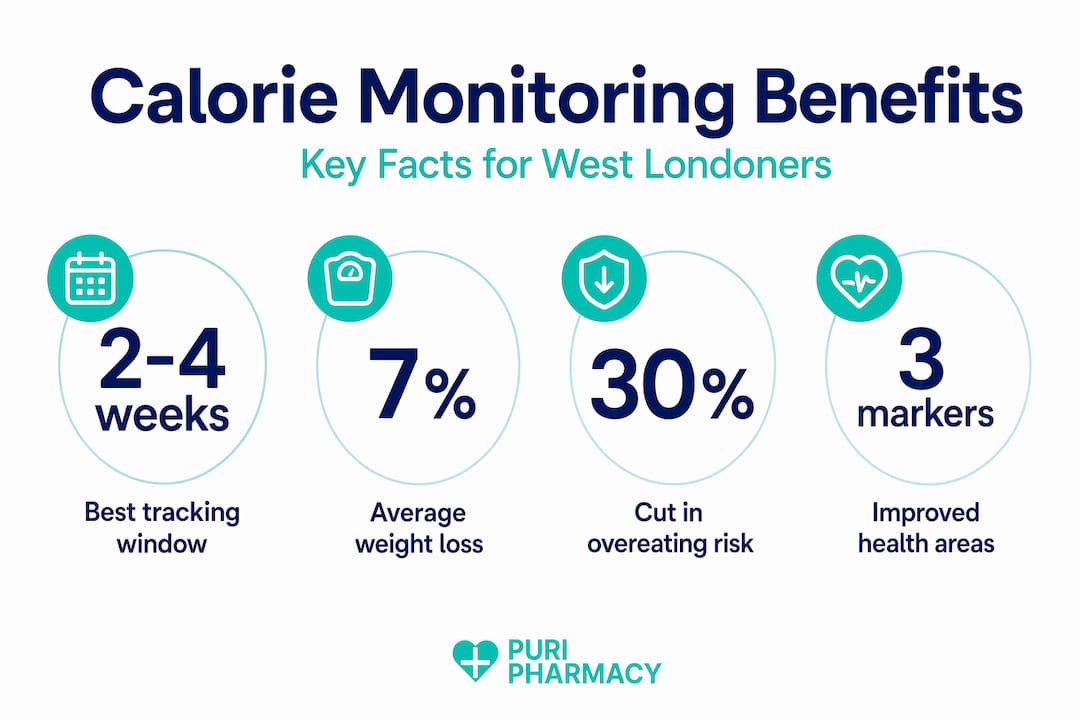
Many people underestimate their intake significantly without any tracking at all. Short, consistent logging recalibrates your portion memory, giving you a lasting internal reference point even after you stop logging.
Practical steps to start effectively:
- Choose awareness over precision. You do not need to weigh every gram. Estimating portions and logging consistently is more valuable than perfect accuracy that you abandon after a week.
- Use apps that support learning, not anxiety. Look for calorie tracking apps that show nutrient breakdowns and patterns, not just daily totals. This keeps the focus on food quality alongside quantity.
- Eat more slowly. This is not vague advice. Slower eating changes how your gut communicates with your brain about fullness, and it meaningfully affects how much you consume at a sitting.
- Track for a defined period. Two to four weeks is enough to generate genuine calorie awareness without the risk of it becoming a source of stress.
- Pair monitoring with one other habit change. Adding a twenty-minute walk after dinner or switching one processed snack for a whole-food alternative amplifies the impact of tracking considerably.
- Seek local support when motivation fades. Our local weight loss services in West London offer clinical guidance when self-monitoring alone is not enough.
The health benefits of calorie counting are most accessible when the process feels manageable. Start small, stay consistent, and treat the data as information rather than judgement.
Rethinking calorie monitoring: beyond numbers to mindful health
Here is something most calorie-counting guides will not tell you: the number on your tracking app is the least important part of the process.
After fifteen years of watching people approach weight management, what becomes clear is that the individuals who sustain their results are not the ones who tracked most precisely. They are the ones who used monitoring as a temporary teacher and then internalised what it taught them.
The evidence on eating pace is striking. Slower eating is associated with more favourable appetite-hormone signalling, meaning that how you eat influences your caloric intake as much as what you track. Calorie monitoring works far better when paired with mindful eating rather than pure number optimisation.
The uncomfortable truth about calorie counting is that it can become a way of avoiding the harder work of actually listening to your body. Logging 1,800 calories feels productive. Sitting with a meal without your phone, noticing when you are genuinely full, and stopping then, is far less comfortable but far more powerful.
Bio-hacking and mindful eating are not opposing ideas. The best version of calorie monitoring is one that gradually makes itself unnecessary by building your internal awareness to the point where the app becomes optional.
For West Londoners, the practical implication is this: use monitoring to learn, not to control. The goal is a healthier relationship with food, not a permanent arithmetic exercise.
How Puri Pharmacy supports your calorie monitoring and weight goals in West London
If you are ready to move from awareness to action, Puri Pharmacy is here to help. We are a West London pharmacy with clinicians who understand that weight management is rarely straightforward.

Our NHS digital weight management programme combines digital self-monitoring tools with structured behaviour change support, giving you the framework that makes calorie monitoring genuinely effective. For those who need additional clinical support, our weight loss service in Southall and Hillingdon offers personalised prescribing consultations. We also provide access to Wegovy weight loss injections for eligible patients where appetite regulation needs physiological support alongside lifestyle changes. Come and speak to our team.
Frequently asked questions
Is calorie counting necessary to lose weight effectively?
No. General calorie awareness is more effective and sustainable than obsessive counting, as it supports long-term behaviour change without the stress of constant tracking.
How long should I track calories to benefit my health?
Short-term tracking of two to four weeks is enough to recalibrate portion awareness. Long-term rigid tracking is not recommended, as it can cause stress and interfere with natural hunger cues.
Can calorie monitoring help with conditions other than weight loss?
Yes. Calorie restriction affects ageing and metabolic health markers, and ongoing research suggests benefits extending well beyond weight management alone.
Are digital tools effective for calorie monitoring and weight loss?
Yes. Stand-alone digital interventions have shown statistically significant weight loss benefits, particularly when combined with broader behaviour-change techniques.
What are the risks of relying solely on calorie tracking?
Over-reliance on tracking can prevent you from learning natural hunger and satiety cues, and may contribute to stress or disordered eating patterns over time.