The role of exercise in weight loss: 2026 guide

TL;DR:
- Exercise is essential for fat loss because it increases calorie expenditure and preserves lean muscle mass during weight reduction. Combining aerobic, resistance, and HIIT exercises offers the most effective and sustainable approach to long-term weight management. Personalized, consistent routines that include at least 150 minutes of moderate activity weekly support both weight loss and maintenance success.
Exercise is the primary mechanism by which the body increases energy expenditure to create the calorie deficit required for fat loss, while simultaneously preserving the lean muscle mass that determines long-term metabolic health. The role of exercise in weight loss extends well beyond simply burning calories during a workout. The CDC confirms that physical activity is essential for weight maintenance, particularly once initial fat loss has been achieved through dietary restriction. Organisations including the NIDDK, ACSM, and the NHS recognise that structured physical activity, when combined with dietary change, produces superior outcomes compared to either approach alone. This guide draws on 2026 research and updated clinical guidelines to explain exactly how exercise aids in losing weight, which types work best, and how to build a routine that lasts.
What is the role of exercise in weight loss?
Exercise contributes to weight loss through two distinct mechanisms. The first is direct calorie expenditure during activity, which widens the gap between calories consumed and calories burned. The second, less discussed but equally important, is the preservation of fat-free mass during a calorie deficit. When you lose weight through diet alone, a significant portion of that loss comes from muscle tissue. Exercise, particularly resistance training, counteracts this.

The NIDDK recommends at least 150 minutes per week of moderate-intensity aerobic activity alongside muscle-strengthening exercises twice weekly to support weight loss. That figure represents the minimum threshold, not the optimal dose. For individuals who are not reducing calorie intake substantially, the CDC notes that a higher weekly volume may be required to produce meaningful results.
Practitioners view weight loss success in two distinct stages. The first is the active fat loss phase, driven primarily by calorie restriction. The second is the maintenance phase, where regular physical activity becomes the dominant factor in preventing weight regain. Understanding this distinction changes how you should think about your fitness routine at each stage of your journey.
Which types of exercise are most effective for fat loss?
Not all exercise produces the same results for fat loss. Aerobic exercise, resistance training, and high-intensity interval training (HIIT) each target different physiological mechanisms, and the evidence for each has become considerably clearer with recent research.
| Exercise type | Primary benefit | Recommended dose |
|---|---|---|
| Aerobic (e.g. brisk walking, cycling) | Calorie burn, cardiovascular health | 150 to 300 minutes per week, moderate intensity |
| Resistance training | Preserves and builds fat-free mass | All major muscle groups, at least twice weekly |
| HIIT | Visceral fat reduction at lower volume | Approx. 400 METs·min/week minimum |
| Combined aerobic and resistance | Body composition and metabolic health | 150 minutes aerobic plus 2 resistance sessions weekly |
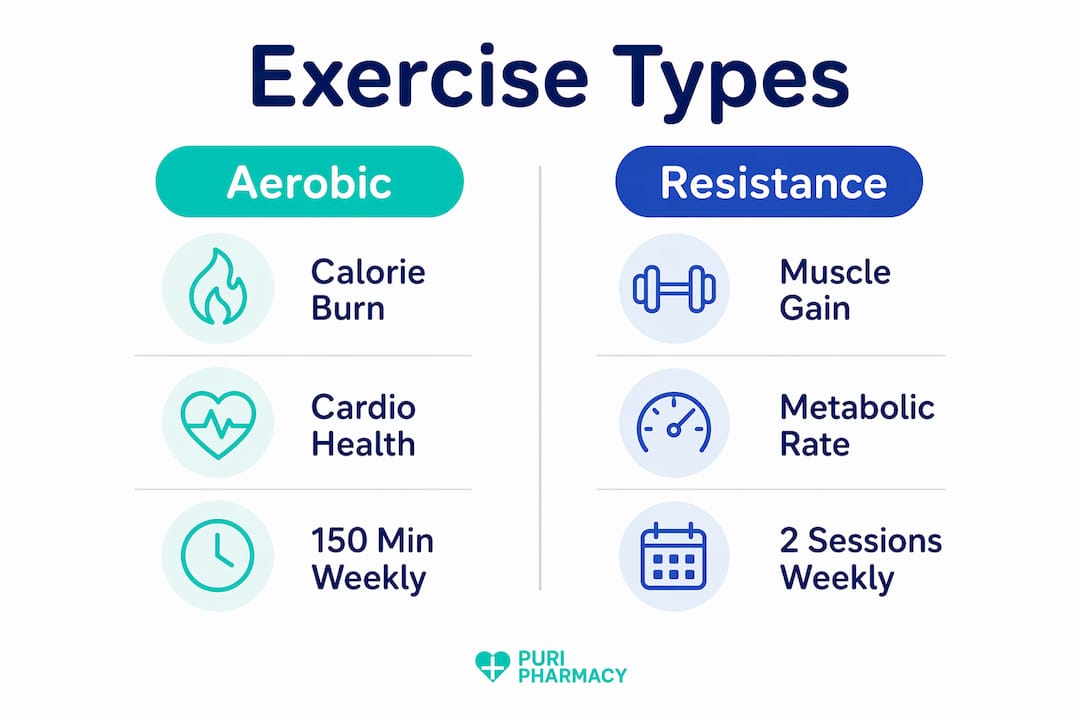
Aerobic exercise remains the most accessible entry point for most people. It burns calories reliably and supports cardiovascular health, making it a sound foundation for any fitness programme for weight loss. The limitation is that aerobic exercise alone does not protect muscle mass during a calorie deficit.
Resistance training addresses precisely that gap. A 2025 study published in Frontiers in Endocrinology found that only resistance training participants gained fat-free mass while simultaneously reducing fat mass during calorie restriction. This body recomposition effect is unique to resistance work and has significant implications for metabolic rate and long-term weight management.
HIIT deserves particular attention. A 2026 meta-analysis found that HIIT achieves significant visceral fat reduction at approximately 400 METs·min/week, a considerably lower volume than aerobic or combined exercise requires. Visceral adipose tissue (VAT) is the metabolically active fat stored around the organs, and reducing it carries substantial health benefits beyond the number on the scales.
The updated ACSM 2026 resistance training guidelines make a point worth highlighting: the single biggest driver of improvement is moving from no resistance training to any consistent resistance training. Training all major muscle groups twice weekly is the critical threshold, not the specific programme design.
Pro Tip: Combining aerobic exercise with resistance training produces greater improvements in body composition than either approach alone. If time is limited, prioritise resistance training twice weekly and add aerobic activity around it.
How does exercise complement dietary strategies?
Diet and exercise are not competing strategies. They are complementary tools that produce substantially better outcomes when used together. A 2026 systematic review published in Frontiers in Nutrition confirmed that combined diet and physical activity programmes outperform diet-only or exercise-only interventions across weight, BMI, and cardiometabolic markers.
The practical implications of this finding are significant. When you restrict calories without exercising, you lose both fat and muscle. When you add structured exercise, particularly resistance training, you redirect that weight loss almost entirely towards fat. The result is a leaner body composition at the same scale weight, which translates to a higher resting metabolic rate and better long-term outcomes.
The benefits of physical activity for weight loss extend beyond the scales. The same research found that longer-term programmes of six to twelve months with resistance training included produced sustained cardiometabolic benefits, including improved glucose control and reduced inflammation, even independent of weight loss itself. This matters because it means exercise is worth doing even during periods when the scales are not moving.
Key reasons why combining diet and exercise outperforms either alone:
- Exercise preserves lean muscle mass that calorie restriction would otherwise reduce
- Physical activity improves insulin sensitivity, making the body more efficient at using carbohydrates for fuel rather than storing them as fat
- Regular movement supports better appetite regulation, reducing the likelihood of overeating
- Structured programmes lasting six months or more produce durable changes in behaviour and body composition
- Resistance-inclusive programmes show the strongest evidence for sustained results
Behaviour change is the underlying mechanism that makes all of this work. The NIDDK emphasises that specific, trackable goals and structured support improve adherence significantly more than general advice to “move more.” Setting a concrete target, such as three resistance sessions and two aerobic sessions per week, gives you something measurable to build on.
What is the role of exercise in maintaining weight loss long-term?
Most people lose weight through calorie restriction. Far fewer keep it off. The reason is metabolic adaptation: as body weight falls, the body reduces its resting energy expenditure, making it progressively harder to maintain a deficit. Regular physical activity is the primary tool for counteracting this adaptation.
The NIDDK recommends at least 300 minutes per week of moderate-intensity activity for individuals seeking to prevent weight regain. That is double the minimum recommendation for initial weight loss. The increase reflects the reality that maintaining a lower body weight requires more sustained effort than the initial loss phase.
A structured approach to long-term maintenance looks like this:
- Establish a baseline. Track your current weekly activity volume before making changes. You cannot manage what you cannot measure.
- Build progressively. Increase weekly activity by no more than 10% per week to reduce injury risk and maintain consistency.
- Prioritise resistance training. Two sessions per week targeting all major muscle groups preserves the muscle mass that keeps your metabolic rate elevated.
- Accumulate aerobic activity. Aim for 300 minutes per week of moderate-intensity movement, spread across the week rather than concentrated into one or two sessions.
- Review and adjust every 8 to 12 weeks. Body composition changes over time, and your programme should evolve with it.
The CDC notes that individual variation is substantial in the volume of activity required for maintenance. Some people maintain their weight at 200 minutes per week; others require considerably more. This is why personalised plans, rather than generic prescriptions, produce better long-term results.
Pro Tip: Consistency beats intensity every time for long-term weight maintenance. Three moderate sessions per week, sustained for twelve months, will outperform six intense sessions per week that you abandon after six weeks.
How can you optimise your exercise routine for weight management?
Building an effective fitness routine for weight loss does not require a perfect programme. It requires a programme you will actually follow. The ACSM’s updated guidelines reinforce this point: the best routine is the one you can maintain consistently over time.
Practical steps for structuring your routine:
- Set specific goals. “Exercise more” is not a goal. “Complete three 45-minute resistance sessions and two 30-minute walks per week” is a goal you can track and build on.
- Mix modalities. Combine aerobic exercise, resistance training, and occasional HIIT sessions to target different physiological systems and prevent boredom.
- Meet the minimum thresholds. At least 150 minutes of moderate aerobic activity and two resistance sessions weekly for weight loss; 300 minutes weekly for maintenance.
- Apply progressive overload. Gradually increase the weight, duration, or intensity of your sessions every two to four weeks to continue driving adaptation.
- Address barriers directly. Time constraints respond to shorter, more frequent sessions. Motivation issues respond to social accountability or working with a personal trainer. Access barriers respond to home-based bodyweight programmes.
- Use tracking tools. Wearables such as Garmin or Fitbit devices, or apps such as MyFitnessPal, provide objective data on activity volume and calorie expenditure that supports better decision-making.
The impact of workouts on weight management is maximised when you listen to your body and build gradually. Injury is the single most common reason people abandon exercise programmes. Starting at 60 to 70% of your perceived maximum effort and building from there is far more productive than launching into daily intense sessions and burning out within a fortnight.
Key takeaways
Exercise drives fat loss through calorie expenditure and preserves lean muscle mass, making it indispensable for both losing weight and keeping it off long-term.
| Point | Details |
|---|---|
| Exercise type matters | HIIT reduces visceral fat at lower doses; resistance training uniquely preserves fat-free mass during calorie restriction. |
| Combined approach wins | Diet plus structured exercise outperforms either strategy alone, particularly in programmes lasting six months or more. |
| Maintenance requires more | Preventing weight regain requires at least 300 minutes of moderate activity per week, double the initial loss threshold. |
| Consistency over intensity | The ACSM confirms that moving from no resistance training to consistent twice-weekly sessions is the single biggest driver of improvement. |
| Personalised plans work | Individual variation in required activity volume is substantial; trackable, specific goals improve adherence and long-term outcomes. |
Why I think most people are approaching exercise for weight loss backwards
After years of working with patients on weight management at Puripharmacy, the pattern I see most often is this: people start with intense exercise, burn out within weeks, and conclude that exercise “doesn’t work” for them. The problem is not the exercise. It is the sequencing.
Most people treat exercise as the primary weight loss tool and diet as the secondary one. The evidence points in the opposite direction. Diet drives the initial calorie deficit far more efficiently than exercise does. Exercise is what determines the quality of that weight loss, whether you lose fat or fat and muscle, and it is what keeps the weight off once you have lost it.
The other misconception I encounter regularly is that more is always better. A 2026 meta-analysis on visceral fat reduction found a nonlinear dose-response relationship, meaning that sporadic intense sessions are less effective than regular accumulation of sufficient volume. Two moderate sessions per week, every week, for a year will outperform two months of daily intense training followed by nothing.
What I tell every patient is this: exercise is a lifelong health investment, not a short-term weight loss intervention. The people who succeed long-term are not those who found the perfect programme. They are those who found something they could do consistently, built it into their routine, and adjusted it as their life changed. That is the standard worth aiming for.
— R
How Puripharmacy can support your weight loss goals

Puripharmacy, based in west London, offers structured weight loss support that integrates clinical guidance with practical lifestyle advice, including physical activity planning. Whether you are starting out or looking to break through a plateau, the team can help you build a programme that fits your life.
The NHS Digital Weight Management Programme available through Puripharmacy provides structured, healthcare-guided support combining dietary advice with physical activity goals. For individuals where clinical intervention is appropriate, Wegovy weight loss injections are available through the private prescribing clinic, designed to complement lifestyle modifications including exercise. You can also explore the full range of weight loss services to find the right starting point for your goals.
FAQ
How much exercise is needed to lose weight?
The NIDDK recommends at least 150 minutes of moderate-intensity aerobic activity per week alongside two muscle-strengthening sessions to support weight loss. If dietary intake is not reduced, a higher volume may be required to create a sufficient calorie deficit.
Is resistance training or cardio better for fat loss?
Both serve different purposes. Aerobic exercise burns more calories per session, while resistance training preserves fat-free mass during calorie restriction, producing better body composition outcomes. A 2025 study found that only resistance training participants gained muscle while losing fat simultaneously.
How does exercise help maintain weight loss?
Regular physical activity counteracts the metabolic adaptation that occurs after weight loss, where the body reduces its resting energy expenditure. The NIDDK recommends at least 300 minutes of moderate activity per week to prevent weight regain.
Is HIIT effective for losing weight?
HIIT is particularly effective at reducing visceral adipose tissue at lower exercise volumes than steady-state aerobic training requires. A 2026 meta-analysis found HIIT achieves significant visceral fat reduction at approximately 400 METs·min/week, making it a time-efficient option for fat loss.
Can I lose weight with exercise alone, without changing my diet?
Exercise alone produces modest weight loss results for most people because dietary intake often increases to compensate for energy expenditure. Combined diet and physical activity programmes consistently outperform exercise-only approaches in both weight reduction and cardiometabolic outcomes.