Why track progress in weight loss: a practical guide

TL;DR:
- Tracking progress enhances awareness of habits and results, leading to better weight loss decisions.
- Using multiple measures beyond the scale, like measurements and fitness, provides more accurate progress indicators.
Most people start a weight loss journey watching the number on the scale like it owes them money. When it stops moving, they assume they’ve failed. That single assumption causes more people to quit than any other mistake in weight loss. Understanding why track progress in weight loss goes far beyond weekly weigh-ins is one of the most important shifts you can make. Progress is happening all around that number. You just need to know where to look, and more importantly, how to use what you find.
Table of Contents
- Key takeaways
- Why track progress in weight loss
- Tracking methods beyond the scale
- How to interpret your tracking data
- Sustainable tracking habits that actually last
- My take: what tracking really teaches you
- How Puripharmacy can support your progress
- FAQ
Key takeaways
| Point | Details |
|---|---|
| Tracking builds awareness | Monitoring your habits and results reveals patterns you’d never notice otherwise. |
| The scale lies by itself | Body measurements, fitness levels, and health markers show progress the scale misses. |
| Plateaus are normal | Weight loss slows as your body adapts; tracking data helps you respond wisely rather than panic. |
| Weekly averages beat daily numbers | Rolling seven-day weight averages reveal real trends without the noise of daily fluctuations. |
| Consistency outperforms perfection | Even simplified, sustainable tracking habits lead to significantly better long-term outcomes. |
Why track progress in weight loss
Tracking progress in weight loss is not about obsession. It’s about awareness. When you monitor what you’re doing and what your body is responding to, you stop guessing and start making decisions with actual evidence.
The psychological benefits are significant. Seeing any form of measurable change, whether it’s a smaller waist measurement or completing a longer walk, provides the kind of positive reinforcement that keeps effort going. Early progress at week four strongly predicts long-term weight loss success, which means the habits you build around tracking in the early weeks matter far more than most people realise.
Here is what consistent tracking actually does for you:
- Increases self-awareness. You start to recognise which meals leave you satisfied, which habits lead to overeating, and which lifestyle factors affect your energy and weight.
- Maintains motivation. Documented wins, however small, remind you that progress is real even when it feels invisible.
- Identifies obstacles early. If something has stalled, tracked data shows you exactly when it started and what changed around that time.
- Supports goal setting. Tracking weight loss milestones gives you concrete targets to work towards rather than a vague ambition to “lose weight.”
- Builds accountability. The importance of tracking weight loss becomes clearest when you realise that high-adherence tracking app users achieve an average loss of 7.0 kg, while low engagement yields almost no results at all.
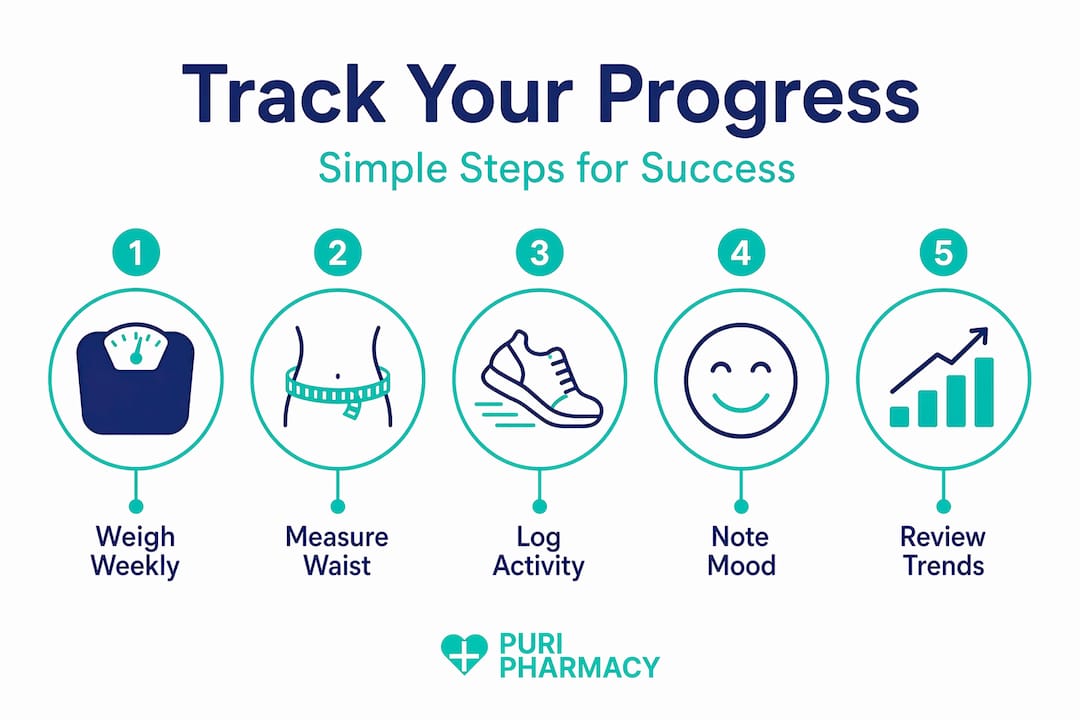
Pro Tip: Start by tracking just three things: your weight once a week, your waist circumference once a fortnight, and how you feel on a scale of one to ten each morning. This alone gives you more useful data than most people ever collect.
Tracking methods beyond the scale
The scale captures one variable: total body weight. That variable includes water, food in your gut, muscle mass, and fat. On any given day, none of those things are stable. Relying on it alone is like judging a film by one frame.
Non-scale progress measures such as waist circumference, energy, mood, and fitness provide essential validation that what you’re doing is actually improving your health. Here are the most effective methods to add to your tracking toolkit:
- Body measurements. Measure your waist, hips, chest, and thighs every two to four weeks. Clothing fit is equally telling. Many people drop a dress size while the scale barely moves, because they are losing fat while building lean tissue.
- Progress photographs. A front and side photo taken in consistent lighting once a month reveals changes your eyes normalise day to day.
- Fitness improvements. Tracking how far you can walk, how many press-ups you can do, or how much you can lift shows that your body is getting genuinely stronger and fitter.
- Health markers. Blood pressure and cholesterol improvements often appear before significant scale changes. Puripharmacy offers an easy way to check your blood pressure so you can track this health marker alongside everything else.
- Mood and energy levels. These are legitimate progress metrics. Better sleep quality, improved focus, and reduced afternoon energy crashes are signs that your body is responding to healthier habits.
The table below shows how different tracking methods compare in terms of frequency, cost, and what they tell you:
| Method | How often | Cost | What it reveals |
|---|---|---|---|
| Scale weight | Weekly | Free | Trend in total body mass |
| Body measurements | Fortnightly | Free (tape measure) | Fat loss, body recomposition |
| Progress photos | Monthly | Free (smartphone) | Visual shape changes |
| Fitness benchmarks | Monthly | Free | Strength and stamina gains |
| Blood pressure | Monthly | Low (pharmacy) | Cardiovascular health improvements |
| Food journal | Daily (short-term) | Free | Habits, portion sizes, calorie patterns |
How to interpret your tracking data
Raw data without interpretation is just noise. Many people collect numbers and then either ignore them or overreact to them. Neither approach helps.
Understanding weight loss plateaus is the starting point. They are normal physiological responses to a calorie deficit, not signs of failure. Your body adapts by slowing metabolism and adjusting hormones. If you see your progress stall, that is information to act on, not a reason to give up.
Here is a practical process for interpreting your data effectively:
- Use weekly averages. Daily weight fluctuates due to water retention and gut content, not actual fat change. Add up seven daily readings and divide by seven. Compare week on week, not day on day. This single change removes most of the emotional turbulence from tracking.
- Track trends over two to three weeks. Tracking trends over 2-3 weeks gives a far clearer picture of fat loss than reacting to any single morning’s reading.
- Audit your habits before adjusting calories. If progress stalls, review your food journal first. Data-driven audits often reveal minor diet or lifestyle leaks, such as untracked drinks, portion creep, or reduced sleep, before any drastic change is needed.
- Check your protein intake. Tracking food intake prevents unnoticed drops in protein that lead to muscle loss, which in turn slows your metabolism and makes fat loss harder.
- Get expert feedback. Self-monitoring combined with coaching leads to better outcomes than going it alone, partly because a professional helps you avoid interpreting a plateau as failure.
Pro Tip: Keep a brief weekly note alongside your numbers: what your sleep was like, your stress level, and anything unusual you ate or drank. This context transforms a confusing plateau into a solvable puzzle.
Sustainable tracking habits that actually last
The biggest mistake in tracking is going all-in immediately and then burning out within three weeks. Keeping a weight loss journal every single day, logging every gram of food, and obsessing over every metric is a reliable path to abandoning the whole thing.

The evidence-based approach is different. Short-term intensive tracking is useful for calibrating your awareness of portion sizes and habits. After four to six weeks, simplified strategies become both sufficient and sustainable. The goal is to build just enough structure to stay on track without making tracking feel like a second job.
Effective weight loss tracking methods that actually last share a few characteristics:
- They match your lifestyle. Someone who travels frequently needs a different approach to someone with a consistent routine. Mobile apps work brilliantly for some; a notepad on the kitchen counter works just as well for others.
- They are specific and milestone-based. Rather than tracking vaguely, set a concrete tracking weight loss milestone, such as “I will measure my waist on the first of every month.” Specificity turns good intentions into habits.
- They use habit stacking. Attach new tracking behaviours to existing ones. Weigh yourself immediately after your morning bathroom visit. Write your food notes while your kettle boils. These nudges require almost no willpower.
- They include non-data wins. Celebrate a week where you cooked at home five nights, or where you walked every day at lunch. Weight loss accountability techniques work best when they recognise behaviour, not just outcome.
- They leave room for real life. Tracking that allows for imperfect days is tracking that continues for months. The goal is an accurate picture over time, not a perfect record on any given day.
The benefits of weight loss tracking compound over time. A person who tracks imperfectly for six months will almost always outperform one who tracks perfectly for three weeks and then stops entirely.
My take: what tracking really teaches you
In my experience working alongside people trying to lose weight, the ones who struggle most are not the ones who lack willpower. They’re the ones who have no idea what’s actually happening in their body week to week. They work hard, the scale does nothing for a fortnight, and they conclude the whole thing isn’t working.
What I’ve found is that the scale is almost always the last thing to move. The blood pressure improves first. The clothes feel different next. The energy shifts. Sleep gets better. All of that happens weeks before the number changes, and if you’re only watching the number, you’re blind to all of it.
I’ve also seen how damaging it is to interpret tracking data emotionally rather than analytically. A 1 kg increase on a Tuesday morning means almost nothing in isolation. But when someone sees that, having not slept well after a salty dinner, and concludes their diet has failed, that’s where tracking does harm rather than good.
My honest advice: treat your data like a weather report, not a verdict. It tells you what conditions are like right now, not whether you’re a success or a failure. The goal of weight loss is gaining health, not just losing a number. The moment you start tracking health rather than just weight, the whole thing gets easier. You have more wins to count, more evidence that your efforts matter, and more reason to keep going.
Kindness and patience with yourself are not optional extras. They are part of the strategy.
— R
How Puripharmacy can support your progress
At Puripharmacy, we understand that losing weight is rarely just about the food you eat. It’s about having the right support around you, particularly when the data gets confusing and motivation dips.

Our weight loss service in west London brings together professional guidance, health monitoring, and evidence-based treatments to support you at every stage. For those who are considering medical support alongside lifestyle changes, our team can advise on options such as Wegovy weight loss injections, a clinically proven treatment for eligible patients that works best alongside structured tracking and behavioural support.
We also support patients through the NHS digital weight management programme, which combines coaching with practical tools to help you interpret your progress and stay on course. Whether you’re just starting out or you’ve hit a frustrating plateau, we’re here to help you make sense of what your data is telling you.
FAQ
Why is tracking progress important in weight loss?
Tracking keeps you aware of your habits and results, which improves decision-making and sustains motivation. Research shows that consistent tracking is one of the strongest predictors of long-term weight loss success.
Should I track more than just my weight?
Yes. Measures such as waist circumference, fitness levels, mood, and health markers like blood pressure often show progress weeks before the scale moves, giving you a more accurate and motivating picture of your results.
How often should I weigh myself?
Weigh yourself once a day at the same time, then use a seven-day average rather than reacting to individual readings. Daily weight fluctuates significantly due to water and food, so the weekly average reflects actual fat loss trends.
What should I do when my progress stalls?
Before cutting calories further, audit your habits. Review your food notes, check your sleep and stress, and look for portion creep or missed protein intake. Plateaus are normal physiological adaptations that usually respond to small targeted adjustments rather than drastic changes.
How long should I track my food intake?
Short-term intensive food tracking for four to six weeks is highly effective for building awareness of portions and habits. After that, most people do well with simplified methods, such as plate templates or periodic check-ins, rather than daily detailed logs.